

Self-assessment of improvement objectives
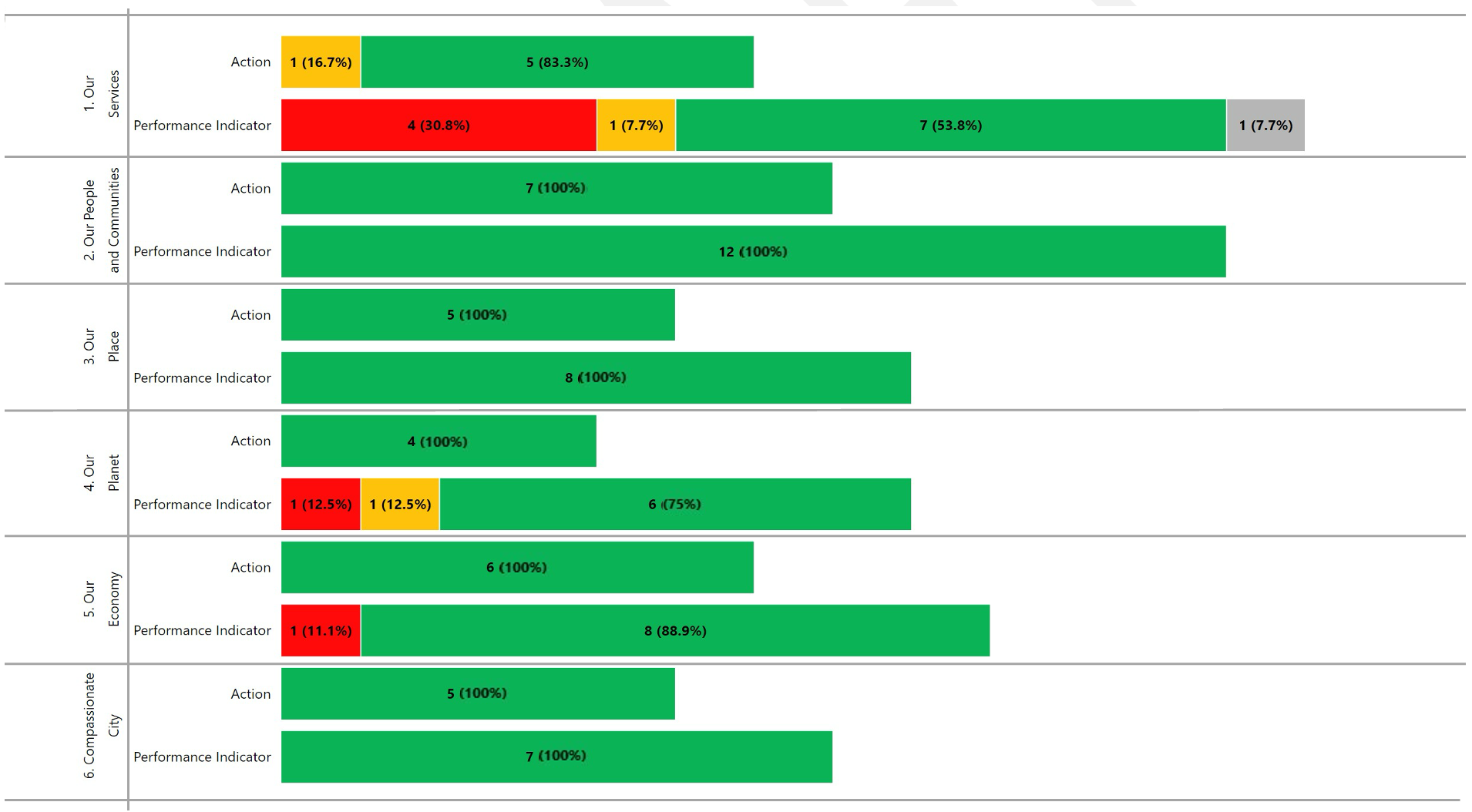
When agreeing the six improvement objectives for 2025-2026, the council identified actions and associated KPIs to ensure achievement of the objectives and improvements that benefit residents, businesses, and other stakeholders. This section of the report provides a summary of performance across the six improvement objectives.
Summary of performance for improvement objective 1: Our services
| Performance indicators on target | Actions on track |
|---|---|
| 53.8 per cent (7) on track 7.7 per cent (1) slightly adrift of target 30.8 per cent (4) not achieved no data available for 7.7 per cent (1) | 83.3 per cent (5) on track 16.7 per cent (1) slightly adrift of target |
Summary of performance for objective 2: Our people and communities
| Performance indicators on target | Actions on track |
|---|---|
| 100 per cent (12) on track | 100 per cent (7) on track |
Summary of performance for objective 3: Our place
| Performance indicators on target | Actions on track |
|---|---|
| 100 per cent (8) on target | 100 per cent (5) on track |
Summary of performance for objective 4: Our planet
| Performance indicators on target | Actions on track |
|---|---|
| 75 per cent (6) on target 12.5 per cent (1) slightly adrift of target 12.5 per cent (1) not achieved | 100 per cent (4) on track |
Summary of performance for objective 5: Our economy
| Performance indicators on target | Actions on track |
|---|---|
| 89.9 per cent (8) on target 11.1 per cent (1) not achieved | 100 per cent (6) on track |
Summary of performance for objective 6: Compassionate city
| Performance indicators on target | Actions on track |
|---|---|
| 100 per cent (7) on target | 100 per cent (5) on track |
Figure 4 Summary of performance across six improvement objectives
This is followed by a self-assessment of each improvement objective providing a progress update on these areas:
- the achievement of the improvement objective
- the achievement of the improvement action
- how we performed – KPIs (self-imposed and statutory), target and trends
- how we compared – performance benchmarking (where relevant and available)
- additional evidence of performance improvement, including impact reports, and
- next steps.
We have assessed each of the 2025-2026 improvement objectives and consider that each met these statutory aspects of improvement:
- general continuous improvement (duty to improve)
- strategic effectiveness
- service quality and availability
- fairness
- sustainability
- efficiency
- innovation
Self-assessment through our community plan (the Belfast Agenda)
Our community plan (the Belfast Agenda) sets out long-term outcomes and ambitions for improving the long-term social, economic, and environmental wellbeing of Belfast as well as immediate priorities. Progress against the Belfast Agenda is monitored and reported through regular reports to Community Planning Partnership Boards and the Strategic Policy and Resources Committee (SP and R).
The council publishes a report every two years, assessing progress towards achieving outcomes and demonstrating the impact on the outcomes for citizens. To access our progress reports, go to Belfast Agenda Progress Reports on YourSay (link opens in new window).
In doing so, we provided evidence of meeting the general duty to secure continuous improvement in the exercise of our functions and addressing multiple complex community needs. Our role in leading the community planning process in Belfast has been pivotal in demonstrating improvement by contributing working collaboratively with cross-sector partners to understand and improve the sustainability of our areas.
Achievement of improvement objective 1: Our services
Did we achieve improvement objective 1: Our services?
Achieved. We continued to adapt and improve our services to better meet the needs of our residents and stakeholders.
Belfast Agenda outcome for improvement objective 1
Belfast is a vibrant, attractive, connected and environmentally sustainable city.
Corporate Plan themes and priorities for improvement objective 1
Our services: Delivering effective and efficient services.
Foundations for success: Creating a fit for purpose organisation.
Actions for improvement objective 1
Six actions
- 100 per cent of actions were either achieved or partially achieved
- 5 (83 per cent) were achieved
- 1 (17 per cent ) was partially achieved
Performance indicators for objective 1
Thirteen performance indicators (target)
- 7 (53.8 per cent) were on target or exceeded target (within 1 per cent or better)
- 1 (7.7 per cent) was slightly adrift of target (between 1 per cent and 5 per cent)
- 4 (30.8 per cent) were adrift of target (more than 5 per cent)
- 1 (7.7 per cent) had no data available
Thirteen performance indicators (trend)
- 10 (76.9 per cent) showed positive change
- 1 (7.7 per cent) showed no significant change
- 2 (15.4 per cent) showed negative change
What did we do to achieve improvement objective 1?
- Achieved: delivered the Customer Focus Programme to build organisational capacity to enhance our services and customer experience.
- Partially achieved: continued to deliver the Planning Service Improvement Plan.
- Achieved: delivered a street cleansing programme to create a cleaner and greener city.
- Achieved: operated daily bin collections of household and commercial waste through the deployment of adequate and efficient resources.
- Achieved: delivered phase two of the kerbside glass expansion programme to enhance customer service and improve recycling rates.
- Achieved: initiated the development of an overarching Asset Management Strategy to set out how council-owned and managed land and property assets will be used to support service delivery and the delivery of objectives in the Corporate Plan and the Belfast Agenda.
How we measured success for improvement objective 1: Our services
| Measure of success | 2021-2022 year end actual | 2022-20223 year-end actual | 2023-2024 year-end actual | 2024-2025 year end actual | 2025-2026 year-end target | 2025-2026 year end actual | Trend (since baseline year) | Commentary (including rationale if negative or adrift) |
|---|---|---|---|---|---|---|---|---|
| Resolving 65 per cent of corporate complaints within timeframe | 72 per cent | 72 per cent | 65 per cent | 64 per cent | 65 per cent | 76 per cent | Improving | Exceeded target by 16.92 per cent resolved more corporate complaints within timeframe than previous year. |
Introducing improvement actions for 80 per cent of corporate complaints | Not applicable | Not applicable | 64 per cent | 72 per cent | 80 per cent | 82 per cent | Improving | Exceeded target by 2.5 per cent and introduced more improvement actions for corporate complaints than previous year. |
| Deliver Customer Service Training qualification to a cohort of staff | Not applicable | Not applicable | Not applicable | Not applicable | One cohort | 1 | Improving | Successfully completed the Customer engagement and design training cohort in quarter 3, with four members of the Customer Focus Team achieving the ICS qualification. |
| Achieving less than 12 weeks average processing time for householder applications and advertisement consent applications | 31 | 19.8 | 20.6 | 17.3 | 12 weeks | 17.8 weeks | Improving | Performance for year end is an average processing time of 17.75 weeks, substantially below the 12-week target. This has been adversely affected by resourcing over summer 2025. |
| Achieving less than six weeks average processing time of tree works applications and Tree Preservation Orders (TPOs) | Not applicable | 2.04 | 7.70 | 3.07 | 6 weeks | 3.3 weeks | Worsening | Target exceeded by 45 per cent |
| Completing 75 per cent of service requests for open spaces and street scene within five working days | 59 per cent | 57 per cent | 62.41 per cent | To be confirmed | 75 per cent | 73 per cent | Improving | Target missed by 2.73 per cent The handling and closure of service requests is being reviewed. |
| Completing 92 per cent of service requests for missed bins within five working days | 89 per cent | 79 per cent | 92 per cent | 91.93 per cent | 92 per cent | 97 per cent | Improving | Target exceeded by 4.97 per cent Increase on previous year. |
| Providing 23,000 additional households with kerb side glass collections | Not applicable | Not applicable | Not applicable | 23,000 | 23,000 | 23,000 | Improving | We provided 23,000 additional households with kerbside glass collections |
| Collecting an additional 650 tonnes of glass | Not applicable | Not applicable | Not applicable | Not applicable | 650 | No data is available | Improving | There were 619 tonnes of kerbside glass collected during phase 1 which was delivered during 2025-2026. Phase 2 kerbside glass collection began in March and April 2026, tonnage will be reported next year. |
| Completing the Asset Management Strategy | Not applicable | Not applicable | Not applicable | Not applicable | 1 | 0 | No significant change | Work is ongoing to develop a strategy. A new single integrated Asset Management System linked to the strategy is being procured to better facilitate management of various assets. |
Statutory indicators for objective 1: Our services
| Statutory indicator | 2021-2022 year end actual | 2022-2023 year-end actual | 2023-2024 year-end actual | 2024-2025 year end actual | 2025-2026 year-end target | 2025-2026 year end actual | Trend (since baseline year) | Commentary (including rationale if negative or adrift) |
|---|---|---|---|---|---|---|---|---|
| Achieving the 15-week target for average processing time for local planning applications | 31 | 19.8 | 20.6 | 17.3 | 15 weeks | 18.1 | Improving | This has been adversely affected by resourcing over summer 2025 as well as variability in the timeliness and quality of consultee responses. |
| Processing 70 per cent of enforcement cases within 39 weeks | 83 per cent | 88.8 per cent | 88.6 per cent | 76.8 per cent | 70 per cent | 86 per cent | Improving | Exceeded target by 22.86 per cent and processed more enforcement cases within 39 weeks than same quarter last year. This is despite a significant increase in complaints received relating to short-term lets. |
| Achieving the 30-week target for average processing time for major planning applications | 31 | 57.2 | 64.4 | 53.2 | 30 | 53 | Worsening | This has been affected by a large number of legacy cases of two years or greater, the quality of applications, delays from consultees and the new Section 76 planning agreements not taking effect until February 2025 with a lag time until the benefits are fully felt. The Planning Service’s commitment to working with customers to achieve a planning permission with quality outcomes, rather than refusing permission within the 30-week target. |
At a local level we:
- introduced new procedures in February 2025 to streamline the Section 76 process.
- published the council’s new Planning Application Validation Checklist in April 2025, which sets mandatory information requirements for planning applications on submission as well as continuing the roll-out of the Planning Service’s new streamlined pre-application discussion process – both of which are expected to have a positive impact on the quality of planning applications received.
For 2026-2027, we are:
- implementing our new Planning Service Performance Framework.
- rolling out a new and comprehensive approach to staff training and development.
- publishing a new internal Development Management Manual to capture complex processes and procedures.
- reviewing our Planning Service Improvement Plan.
- implementing further process improvements following formal reporting on the lean systems redesign experimentation undertaken between 2022 and 2024.
Work continues at a regional level to improve the NI planning system and to develop a new Regional Performance Framework. It is believed that Belfast is the first council to introduce a performance framework based on this regional work. The council took a lead role in the Regional Planning Improvement Programme (PIP), and this is now moving to Phase 2. The NI Audit Office and NI Assembly Public Accounts committee are aware of the systemic issues with the operation of the NI planning system. Performance continued to be impacted by the backlog of legacy applications, the Section 76 process where process improvements are not expected to take effect until 2026-2027, as well as delayed consultation responses from statutory consultees.
How do we compare with other planning authorities?
The volume of all planning applications processed by all councils in 2025-2026 was the lowest since Local Government Reform in 2015-2016 and from records began in 2002-2003. Belfast received 14.2 per cent (1,371) of all Northern Ireland planning applications in 2025-2026 and 13.3 per cent (1,170) of all planning decisions across Northern Ireland. Our performance in relation to other councils is set out in the tables for major and local planning decisions.
Major planning applications
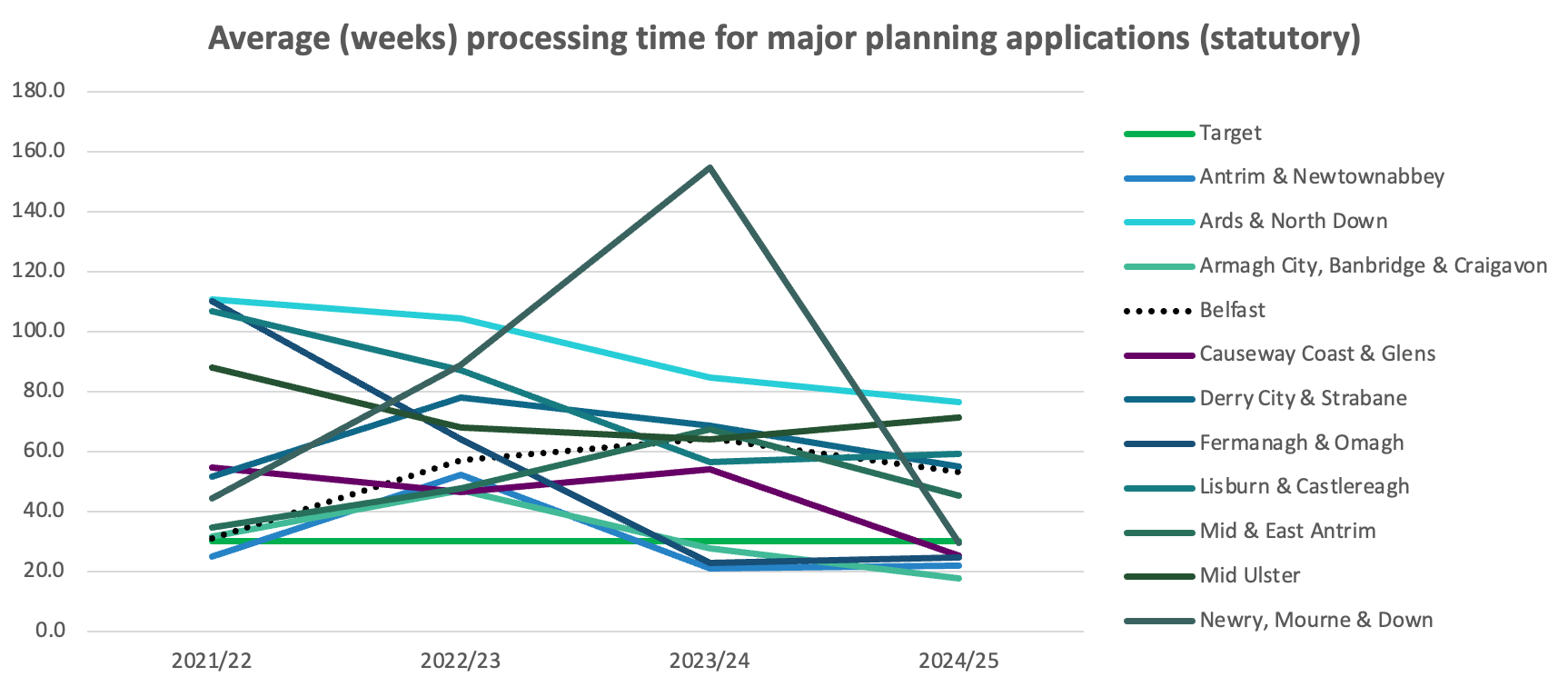
Major planning applications are of economic, environmental, and social importance. Since 2017-2018, Belfast has processed on average 30 major planning applications a year. In 2024-2025, the majority (nine out of 11) of councils did not meet 30-week target, including Belfast which ranked eighth out of 11 councils.
Average processing time (weeks) for major planning applications (statutory) in Northern Ireland
Average processing time in weeks for major planning applications by each council between 2021 and 2026 is shown in this table:
| Council area or organisation | 2021-2022 | 2022-2023 | 2023-2024 | 2024-2025 | 2025-2026 |
|---|---|---|---|---|---|
| Belfast | 31 | 57.2 | 64.4 | 53.2 | 53 |
| Antrim and Newtownabbey | 25.1 | 52.1 | 21.1 | 21.8 | 26 |
| Ards and North Down | 110.8 | 104.5 | 84.7 | 76.6 | 202.7 |
| Armagh, Banbridge and Craigavon | 31.6 | 47 | 27.6 | 17.8 | 37.4 |
| Causeway Coast and Glens | 54.6 | 46.4 | 54.2 | 25.2 | 26.1 |
| Derry City and Strabane | 51.6 | 78 | 68.6 | 55 | 39.7 |
| Fermanagh and Omagh | 110.2 | 64 | 22.9 | 24.5 | 37.4 |
| Lisburn and Castlereagh | 106.8 | 87.2 | 56.4 | 59.2 | 62.4 |
| Mid and East Antrim | 34.7 | 47.6 | 67.4 | 45.2 | 47.7 |
| Mid Ulster | 88 | 68.1 | 64 | 71.4 | 45.9 |
| Newry, Mourne and Down | 44.3 | 89 | 154.8 | 29.6 | 58.8 |
Graph showing average processing time in weeks for major planning applications by councils between 2021 and 2026
Local planning applications
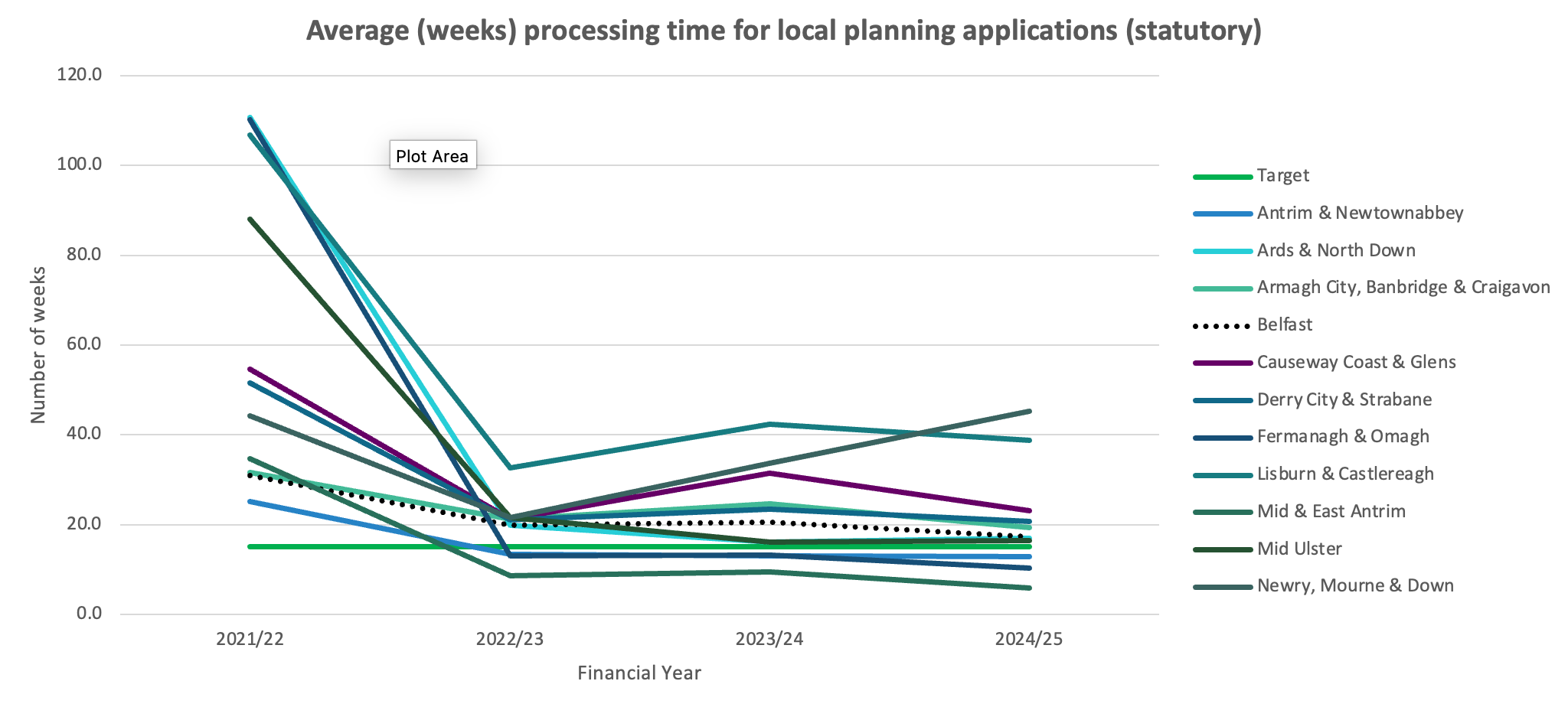
Local planning applications are normally residential and smaller commercial applications. In 2025-2026, the majority (8 out of 11) of councils did not meet the 15-week target, including Belfast which ranked third out of 11 councils. We processed local planning applications more quickly in 2025-2026 than in the baseline year 2021-2022. We have improved in the sense that we have more than halved the average number of weeks it takes to process local planning applications since 2018-2019, despite the ongoing issues with the Regional Planning IT systems outlined earlier in this report.
Average processing time in weeks for local planning applications (statutory) in Northern Ireland
Average processing time in weeks for local planning applications by each council between 2021 and 2026 is shown in this table:
| Council area or organisation | 2021-2022 | 2022-2023 | 2023-2024 | 2024-2025 | 2025-2026 | |
|---|---|---|---|---|---|---|
| Belfast | 31 | 19.8 | 20.6 | 17.3 | 18.1 | |
| Antrim and Newtownabbey | 25.1 | 13.4 | 13 | 12.8 | 13 | |
| Ards and North Down | 110.8 | 19.9 | 16 | 17 | 16.3 | |
| Armagh, Banbridge and Craigavon | 31.6 | 21.2 | 24.6 | 19.4 | 21.8 | |
| Causeway Coast and Glens | 54.6 | 21.2 | 31.4 | 23 | 18.2 | |
| Derry City and Strabane | 51.6 | 21 | 23.4 | 20.7 | 25.2 | |
| Fermanagh and Omagh | 110.2 | 13 | 13.2 | 10.2 | 7.6 | |
| Lisburn and Castlereagh | 106.8 | 32.7 | 42.4 | 38.8 | 29.4 | |
| Mid and East Antrim | 34.7 | 8.6 | 9.4 | 5.8 | 7.6 | |
| Mid Ulster | 88 | 21.6 | 16.1 | 16.5 | 22.4 | |
| Newry, Mourne and Down | 44.3 | 21.6 | 33.7 | 45.2 | 45.8 | |
| All councils | 49.8 | 19 | 20.8 | 19 | 19.6 |
Graph showing average processing times in weeks for local planning applications between 2021 and 2026
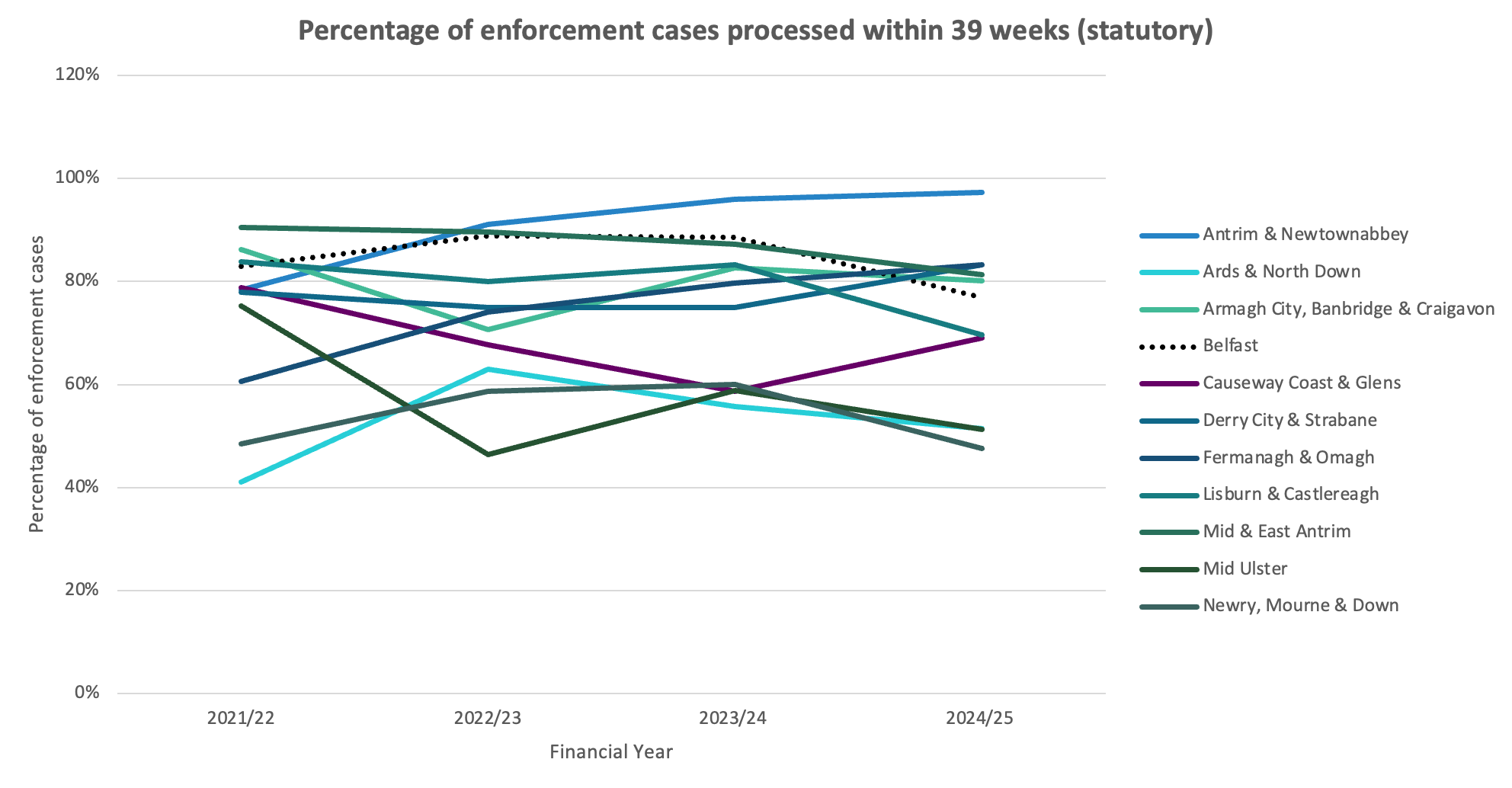
Percentage of planning enforcement cases processed by councils in Northern Ireland within 39 weeks
The number of enforcement cases opened and closed during 2025-2026 across Northern Ireland was the lowest since 2015-2016. Most councils exceeded the 70 per cent target in 2025-2026, with Belfast ranked second out of 11 councils.
Percentage of planning enforcement cases processed by each council between 2021 and 2026 is shown in this table:
| Council area or organisation | 2021-2022 (per cent) | 2022-2023 (per cent) | 2023-2024 (per cent) | 2024-2025 (per cent) | 2025-2026 (per cent) |
|---|---|---|---|---|---|
| Belfast | 83 | 89 | 89 | 77 | 86 |
| Antrim and Newtownabbey | 78 | 91 | 96 | 97 | 94 |
| Ards and North Down | 41 | 63 | 56 | 51 | 58 |
| Armagh, Banbridge and Craigavon | 86 | 71 | 83 | 80 | 80 |
| Causeway Coast and Glens | 79 | 68 | 59 | 69 | 71 |
| Derry City and Strabane | 78 | 75 | 75 | 83 | 73 |
| Fermanagh and Omagh | 61 | 74 | 80 | 83 | 83 |
| Lisburn and Castlereagh | 84 | 80 | 83 | 70 | 68 |
| Mid and East Antrim | 90 | 90 | 87 | 81 | 73 |
| Mid Ulster | 75 | 46 | 59 | 51 | 59 |
| Newry, Mourne and Down | 49 | 59 | 60 | 48 | 58 |
| Northern Ireland | 70 | 74 | 76 | 71 | 75 |
Graph showing percentage of planning enforcement cases processed within 39 weeks between 2021 and 2026
What other activities were completed for improvement objective 1: Our services?
Through our Corporate Plan 2025-2028 and supporting Corporate Delivery Plan 2025-2026 we also:
- achieved 81 per cent customer satisfaction with the (Customer Hub).
- achieved a 4.2 overall customer satisfaction rate (out of five) in Greenwich Leisure Limited (GLL) customer satisfaction survey and won the Excellence in Contribution to the Community at the Belfast Business Awards.
- achieved the UK Quality Accreditation for Sport and Leisure (Quest) in 14 leisure centres.
- managed more than 4,000 community safety issues across the city via the newly launched Community Safety Report It App, supporting a co-ordinated response to a wide range of community safety issues, including drug misuse, antisocial behaviour and welfare check for some of the city's most vulnerable residents.
- embraced AI to modernise service delivery by:
- agreeing our Generative AI Policy
- progressing the £5 million AI adoption programme for the six Belfast Regional City Deal (BRCD) councils.
- invested £75,000 to introduce Belfast Zoo's new hop-on, hop-off accessible train to improve inclusivity at the venue.
- commenced a Transformation and Efficiency Programme to ensure the most efficient use of council resources, minimise the rates burden on householders and businesses and create a sustainable medium term financial strategy.
- implemented numerous customer service improvements as a result of customer complaints.
- identified and implemented several risk actions and audit recommendations to mitigate the impact or likelihood of risks transpiring that may interrupt delivery.
- delivered a range of service and human resources (HR) improvement projects through our dedicated Continuous Improvement Unit.
- undertook a variety of consultations via the council’s engagement platform Your Say Belfast to establish areas for action and improvement, including tackling dog fouling and transforming alleyways.
What was the impact of improvement objective 1: Our services?
Reliable services, delivered daily
- 99.8 per cent bin collection rate
- 10 million bin and box collections
- over 62,000 tonnes of materials recycled
- 564 tonnes of waste landfilled – our lowest level to date
- 97 per cent closed missed bin service requests complete within five working day (up from 92 per cent in 2024-2025)
- 13 smart compactor bins installed across the city that hold up to five times more waste, alert staff when bins are full, boosts recycling, and cuts fuel use and emissions by reducing collection journeys by over 80 percent
Key achievements
- Secured funding for two additional narrow access vehicles to improve access to areas that standard vehicles cannot reach
- Approved a Single use Plastic Policy and action plan to support the avoidance, reduction and replacement of single-use plastics
- Rolled out a city-wide bin tagging system to help households use the right bins and prevent overflowing
- Piloted a dog-fouling hotspot project that saw a reduction in reports of dog fouling.
- Secured £757, 522 for enhanced power-washing
- Four additional Resource Advisors to be recruited to assist residents with managing their waste and improve recycling
- ISO9001, 14001 and 45001 integrated management systems for waste management maintained
- 66 per cent city centre cleanliness index
Overall, the process of implementing improvement actions arising from complaints is driving real benefits. It is helping to reduce repeat complaints, tackle recurring service issues, and embed more sustainable long-term improvement. It is also strengthening governance, audit assurance, and operational efficiency by helping services learn from customer feedback and act on it.
Customer Focus Programme
Our team who collect from us in BT9 are brilliant – a really friendly crew. We can’t fault them in anyway, so thank you to our bin collection team.
Customer
What are next steps for improvement objective 1: Our services?
This improvement objective is included in the Performance Improvement Plan 2026-2027 as:
- We will continue to adapt and improve our services to better meet the needs of our residents and stakeholders.
Improving our services is identified as a key priority in our Corporate Plan 2025-2028:
- Our services – Delivering effective and efficient services.
- Foundations for success - creating a fit for purpose organisation.
Improvement objective 2: Our people and communities
Did we achieve improvement objective 2: Our people and communities?
Achieved. We improved our local areas and provide opportunities to support our residents to become healthier and engaged.
Belfast Agenda outcome for improvement objective 2
Belfast will be a city where everyone experiences good health and wellbeing.
Corporate Plan themes and priorities for improvement objective 2
- Our people and communities – Making life better for all our residents.
- Health inequalities and community and neighbourhood
Seven actions for improvement objective 2
- 100 per cent of actions were achieved or completed
Twelve performance indicators (target) for improvement objective 2
- 12 (100 per cent) were on target or exceeded target (within 1 per cent or better)
Twelve performance indicators (trend) for improvement objective 2
- 12 (100 per cent) showed positive change
What did we do to achieve improvement objective 2: Our people and communities?
- Achieved: enhanced our playgrounds, to ensure that we continue to provide high quality facilities and equipment across the city.
- Achieved: increased the number of people using our leisure centres, to participate in sport and physical activity.
- Achieved: delivered animation and outreach activities in community, play, and leisure development programmes.
- Achieved: delivered and facilitated a range of events and community programmes within our parks and open spaces.
- Achieved: delivered improvements to parks and open spaces to improve people’s health and wellbeing through multimillion pound transformational schemes.
- Achieved: progressed the development of capital projects aligned to the Physical Activity and Sports Development Strategy and Pitches Strategy to enhance the quality and accessibility of sports and physical activity provision in Belfast.
- Achieved: progressed the development and delivery of the council’s Physical Programme to enable needs led investment across the city.
How we measured success for improvement objective 2: Our people and communities
| Measure of success | 2021-2022 year end actual | 2022-2023 | 2023-2024 year-end actual | 2024-2025 year end actual | 2025-2026 year-end target | 2025-2026 year end actual | Trend (since baseline year) | Commentary (including rationale if negative or adrift) |
|---|---|---|---|---|---|---|---|---|
| Investing £580k and delivering the annual playground improvement programme | Not applicable | Not applicable | £580,000 | £580,000 | £580,000 | £580,000 | Improving | White Rise, and Ohio Street playgrounds complete. Finroy Street nearly complete. We began fencing work at Rodden Crescent. Playground refurbishment will begin on site in quarter 1 2026-2027. |
| Increasing the number of people to our leisure centres to 3.35million | 2,810,202 | 3,100,000 | 3,108,894 | 3,168,967 | 3,350,000 | 3,620,303 | Improving | Target exceeded by 8 per cent. There were 451,336 more leisure centre visits than previous year. |
| Increasing the number of community, play and leisure outreach programmes delivered to 200 | Not applicable | Not applicable | Not applicable | Not applicable | 200 | 266 | Improving | Target exceeded by 33 per cent. Provisional data. |
| Increasing the number of outdoor leisure bookings (pitches, bowling greens) to 16,000 | 8,876 | 10,859 | 14,470 | 16,153 | 16,000 | 18,190 | Improving | Target exceeded by 13.69 per cent. There were 2,676 more bookings than previous year. |
| Increasing the numbers attending events in our parks to 180,000 | 16,755 | 195,640 | 175,620 | 203,654 | 180,000 | 181,665 | Improving | Target exceeded by 0.9 per cent. Hosted 413 events in our parks. |
| Progressing major improvements to three parks (Ballysillan Playing Fields, Waterworks and Alexandra Park) | Not applicable | Not applicable | Not applicable | Not applicable | 3 | 3 | Improving | Improvement works to all three parks continue to progress. |
| Progressing major improvements to one open space (Cathedral Gardens) | Not applicable | Not applicable | Not applicable | Not applicable | 1 | 1 | Improving | Progressing well on site and due to complete in winter or spring 2027. |
| Commencing development work on three selected sites (aligned to the Leisure Programme, Physical Activity and Sports Development Strategy and Pitches Strategy) | Not applicable | Not applicable | Not applicable | Not applicable | 3 | 3 | Improving | Prioritised list agreed: Shankill, Whiterock and Girdwood. Pitches Strategy presented to SP and R Committee in April 2026. |
| Completing 10 projects under the Physical Programme | Not applicable | Not applicable | Not applicable | 26 | 10 | 39 | Improving | Target was achieved in quarter 3. Additional 29 projects completed. |
| Developing 100 projects under the Physical Programme | Not applicable | Not applicable | Not applicable | 128 | 100 | 220 | Improving | Exceeded target. Physical Programme dashboard reported 220 live projects at various stages. There are: 26 projects on ground, on site or contractor appointed; 70 underway at design stage or planning. Remainder at different stages, for example development work ongoing or surveys. |
| Supporting 20 organisations under the £10.28million Neighbourhood Regeneration Fund (NRF) programme | Not applicable | Not applicable | Not applicable | Not applicable | 20 | 20 | Improving | Continuing to support 20 organisations at stage 3. Four projects on site. One building purchase complete in 2025-2026 and funding expended, Market Heritage Hub. |
| Completing one project under NRF | Not applicable | Not applicable | Not applicable | Not applicable | 1 | 1 | Improving | One building purchase complete in 2025-2026 and funding expended, Market Heritage Hub project. Four other projects on site and due to complete in 2026-2027: Belfast Orange Hall refurbishment, Michael Davitt's Community Heritage Centre, ACT Visitor Centre, Solas. NRF-funded element of Michael Davitt's completed in March 2026, Heritage funded aspect being delivered by group and to complete by summer 2026 |
What other activities were completed for improvement objective 2: Our people and communities?
Through our Corporate Plan 2025-2028 and supporting Corporate Delivery Plan 2025-2026 we also:
- opened a new dog park at Ormeau Park, providing a safe and welcoming space for dogs and their owners.
- supported 135 people who are impacted by, or at risk of, chronic homelessness (target 50) through the Complex Lives Programme.
- invested £170,000 to install 98 communication boards at all playgrounds across the city.
- supported 23 schools and 20 youth organisations to achieve Take 5 accreditation which recognises the steps that they take to support positive mental health.
- engaged over 1,500 older people in activities to help enhance the quality of life for people as they age.
- delivered a Living Library event to promote good relations, inclusion and community understanding across the city.
- unveiled the first legal street art wall at Little Patrick Street which supports local artists and help deter graffiti and tagging.
- delivered the Belfast Canvas programme, which has transformed over 130 utility and junction boxes across the city into vibrant public artworks created by local, national, and international artists.
- funded a range of creative community projects across the whole city through our Bank of Ideas participatory budgeting initiative.
- provided a range of opportunities for our residents to become healthier and engaged through our extensive city and park events, leisure centre holiday schemes, community centre programmes.
- delivered key programmes such as the Equality Action Plan 2020-2024, Disability Action Plan 2022-2025, Age Friendly Belfast Plan 2022- 2026 and our Language Action Plan 2023-2026.
- ensured our programmes and policies are inclusive by fulfilling our obligations under the S75 NI act through equality screening.
- engaged extensively through our ongoing engagement mechanisms (YourSay Belfast and established staff and public forums).
What is next for improvement objective 2: Our people and communities?
This improvement objective features in the Performance Improvement Plan 2026-2027 where:
- We will improve our local areas and provide opportunities to support our residents to become healthier and engaged.
- Our people and communities continue to feature as a strategic theme of the refreshed Belfast Agenda and is a key priority in our Corporate Plan 2025-2028.
What was the impact of improvement objective 2: Our people and communities?
Active lives, sporting pride
- 31,145 memberships (up from 30,485 in 2024-2025)
- £800,000 invested to upgrade and expand three sports pitch facilities
- 1,460 people supported through the 12-week Healthwise programme
- £800,000 invested in gym refurbishments and the creation of party spaces
Key achievements
- Celebrated 10 years of partnership with GLL
- Announced as a European City of Sport for 2026
- Hosted the 17th Belfast Sports Awards - presenting 14 awards across seven categories
The Healthwise Programme gave me the confidence and opened the door to make me more aware of my health, and everything involved. I would have been lost without that support. The support was fantastic.
Programme participant
The successful European City of Sport bid gives the city an opportunity to showcase the excellent sports and leisure facilities provided by Belfast City Council along with the city's rich sporting heritage.
Director Neighbourhood Services
Improvement objective 3: Our place
Did we achieve improvement objective 3: Our place?
Achieved. We created a more vibrant, attractive, and connected city (including the city centre).
Belfast Agenda outcome for improvement objective 3
Belfast will be a vibrant, attractive, connected and environmentally sustainable city.
Corporate Plan themes and priorities for improvement objective 3
- Our place: Creating a liveable and connected, vibrant and competitive city.
- Connectivity, active and sustainable travel
- City regeneration and investment
Five actions for improvement objective 3
- 100 per cent of actions were achieved or completed.
Eight performance indicators (target) for objective 3
- 8 (100 per cent) were on target or exceeded target (within 1 per cent or better)
Eight performance indicators (trend) for objective 3
- 8 (100 per cent) showed positive change
What did we do to achieve improvement objective 3: Our place?
- Achieved: continued to deliver the Vacant to Vibrant (V2V) Programme 2025-2026 to address citywide vacancy rates.
- Achieved: progressed the Greenways and Access to the Hills Programme to improve the connectivity of the city.
- Achieved: supported and progressed the delivery of neighbourhood tourism physical projects, improving the city’s local tourism facilities and infrastructure.
- Achieved: progressed infrastructure works at the North Foreshore to support the development of the site.
- Achieved: progressed the Master Development Agreement for the 250-acre Giant’s Park site in accordance with the schedule of works.
How we measured success for improvement objective 3: Our place
| Measure of success | 2021-2022 year end actual | 2022-2023 year-end actual | 2023-2024 year-end actual | 2024-2025 year end actual | 2025-2026 year-end target | 2025-2026 year end actual | Trend (since baseline year) | Commentary (including rationale if negative or adrift) |
|---|---|---|---|---|---|---|---|---|
| Occupying 20 previously vacant citywide properties as a result of the Vacant to Vibrant intervention | Not applicable | Not applicable | 17 | 46 | 20 | 24 | Improving | The annual target was achieved and exceeded (by 20 per cent) in quarter 2 with grant awards to 24 applicants |
| Awarding £470,000 through Vacant to Vibrant funding to citywide traders | Not applicable | £92,433 | £301,136 | £839,204 | £470,000 | £519,000 | Improving | Achieved and exceeded in quarter 2. Includes underspends from UKSPF |
| Progressing two greenways and pathways to improve the connectivity of the city (Sydenham Greenway, Colin Greenway, and Black Mountain Pathway | Not applicable | Not applicable | Not applicable | Not applicable | 2 | 2 | Improving | Continue to progress work on greenway projects |
| Progressing three physical neighbourhood tourism projects: Act Initiative, Titanic People Exhibition Centre, and Michael Davitt's Community Heritage Centre | Not applicable | Not applicable | Not applicable | Not applicable | 3 | 3 | Improving | Successfully progressed work on three tourism projects |
| Progressing match funding for three projects from external partners for neighbourhood tourism physical projects | Not applicable | Not applicable | Not applicable | Not applicable | 3 | 3 | Improving | Working with groups to secure funding for tourism initiatives including Market Heritage Hub. Secured some funding from DfC towards historic cemeteries |
| Undertaking works with the developer to progress the development phase of the 250-acre Giant’s Park | Not applicable | Not applicable | Not applicable | Not applicable | 1 | 1 | Improving | Progressing well and going through Planning: Phase 1 Adventure Hub |
| Progressing the delivery of landfill gas extraction system at the North Foreshore | Not applicable | Not applicable | Not applicable | Not applicable | 1 | 1 | Improving | Gas extraction system works progressing. A minor delay saw the contractor demobilise from site in February. Works completed in late April |
| Progressing the delivery of additional Northern Ireland Electricity (NIE) capacity at the North Foreshore | Not applicable | Not applicable | Not applicable | Not applicable | 1 | 1 | Improving | NIE continues with these works, anticipated completion date in late 2027. Phase 2 works from Duncrue to Giant's Park were completed in March 2026. NIE will next proceed to phase 3 works inside Giant's Park. |
What other activities were completed for improvement objective 3: Our place?
Through our Corporate Plan 2025-2028 and supporting Corporate Delivery Plan 2025-2026 we also:
- progressed delivery of the housing-led regeneration programme, working in partnership with the Private Sector Partner (PSP) and external partners.
- invested £4.2m in the cultural sector – supporting 152 organisations through grants and partnerships, and providing 35 creative bursaries, mentorships, and commissions.
- welcomed the return of Culture Night after a six-year hiatus since 2019:
- 158 events were delivered across the city by 182 participating organisations, venues, and artists
- £49,482 was distributed to support artists and venues
- estimated attendance of approximately 50,000 people across the city
- 86 per cent of audiences rated their overall experience as good or very good.
- estimated total economic impact of approximately a minimum £1.67 million for the city.
- At our various events and venues there were:
- 57,000 people at the Maritime Festival and over 25,000 people at our St Patrick’s Day celebrations.
- 152,878 visitors at Belfast Zoo and over 273,782 visitors at 2 Royal Avenue.
- 107,213 visitors to our City Hall exhibition and guided tours.
- bought the historic, listed Assembly Rooms building as part of the ongoing city centre regeneration drive.
- successfully bid to host Comhaltas Fleadh Cheoil na hÉireann 2026 and were confirmed as the host city for Comhaltas Fleadh Cheoil na hÉireann in 2027
- leveraged $1 million from Bloomberg Philanthropies Mayors' Challenge 2025–2026 to help transform Belfast alleyways, and
- won the NILGA Engaging Communities Award for Belfast 2024 Programme.
What are next steps for improvement objective 3: Our place?
This improvement objective will feature in the Performance Improvement Plan 2026-2027:
- Our place: we will create a more vibrant, attractive, and connected city (including city centre).
Our place continues to feature as a strategic theme of the refreshed Belfast Agenda and is a key priority in our Corporate Plan 2025-2028.
What was the impact of improvement objective 3: Our place?
Physical Investment Programme – making Belfast a better place to live, work and invest
- over £750million investment
- over 220 live projects
- 450 projects completed
- 10 live Landmark projects (over £1million)
- eight live Transformational projects (over £5million)
In 2025-2026, 39 projects were completed, including:
- Sandy Row Arts and Digital Hub, Urban Villages project
- ABC Trust Health and Leisure Hub (£7.3million), Urban Villages project
- Phase 2 of Black Mountain Shared Space Community Office Units (£2.4million), and
- Castlereagh Presbyterian Church Hall (£382,000).
These projects:
- created shared, accessible, and welcoming spaces
- provided community benefits
- connected people from diverse backgrounds, and
- enriched the physical and social environment.
The Arts and Digital Hub is a major step forward for Sandy Row, representing a significant investment in local people and transforming a vacant site into a vibrant centre for creativity, digital learning and opportunity.
Belfast South Community Resources
Vacant to Vibrant Programme 2025-26 – bringing Belfast to life
- £500,000 capital investment of grant awards (DfC and UKSPF)
- 24 properties occupied
- 83 direct employment opportunities created
- £911,778 estimated rates return over the course of the lease (subject to LPS valuation)
- £3.15 return on every £1 invested
- £700,000 secured to extend the scheme in 2026 to 2027
Key achievements
- Creating jobs
- Generating investment and rates income
- Creating greater vibrancy and footfall
- Restoring built heritage
- Building capacity in organisations for capital projects
- Making Belfast a more attractive place to live and visit
The result is a visible presence in South Belfast to bring community groups together. Vacant to Vibrant has been the catalyst for change, it allowed us to dream big.
Chief Executive Officer, Forward South Partnership
Improvement objective 4: Our planet
Did we achieve improvement objective 4: Our planet?
Achieved. We championed climate action, protected the environment and improved the sustainability of Belfast
Belfast Agenda outcome for improvement objective 4
Belfast is a vibrant, attractive, connected and environmentally sustainable city.
Corporate Plan themes and priorities for improvement objective 4
Our services, Our people and communities, Our place, and Our planet
Four actions for objective 4
- 100 per cent of actions were achieved or completed
Eight performance indicators (target) for objective 4
- six (75 per cent) were on target or exceeded target (within 1 per cent or better)
- 1 (12.5 per cent) was slightly adrift of target (between 1 per cent and 5 per cent)
- 1 (12.5 per cent) were adrift of target (more than 5 per cent)
Eight performance indicators (trend) for objective 4
- eight (100 per cent) showed positive change
What did we do to achieve improvement objective 4: Our planet?
- Achieved: progressed the planet section of the Belfast Agenda, which aims to create a sustainable, nature positive city (including investable local energy projects, an UPSURGE demonstrator site and a neighbourhood retrofit pilot).
- Achieved: commenced delivery of the council's Corporate Climate Action Plan to increase the climate resilience of council assets and services and progress towards the council's net zero emissions, (over 20 priorities including a Sustainable Food Policy, energy audits of council buildings and retrofitting of council buildings).
- Achieved: delivered an effective waste management service across the city.
- Achieved: delivered year three of the Belfast Tree Strategy and action plan to help manage and improve the tree scape across the city, including the establishment of the woodland management programme.
How we measured success for improvement objective 4: Our planet
| Measure of success | 2021-2022 | 2022-2023 year-end actual | 2023-2024 year-end actual | 2024-2025 year end actual | 2025-2026 year-end target | 2025-2026 year end actual | Trend (since baseline year) | Commentary (including rationale if negative or adrift) |
|---|---|---|---|---|---|---|---|---|
| Progressing three Belfast Agenda Climate Projects (investable local energy projects, UPSURGE demonstrator site, neighbourhood retrofit pilot) | Not applicable | Not applicable | Not applicable | Not applicable | 3 | 3 | Improving | UPSURGE and UP2030 work are completed. Work is ongoing in relation to the investable local energy projects. |
| Completing one Belfast Agenda Climate Project (Horizon Europe UP2030) | Not applicable | Not applicable | Not applicable | Not applicable | 1 | 1 | Improving | Achieved in quarter 2. |
| Progressing 19 short-term council Corporate Climate Action Plan priorities | Not applicable | Not applicable | Not applicable | Not applicable | 19 | 18 | Improving | The council's corporate climate actions are being progressed, 18 were in progress in quarter 4. |
| Achieving 38.5 per cent of council municipal waste arisings is sent for recycling | 37.87 per cent | 37.06 per cent | 38.8 per cent | 39.4 per cent | 38.5 per cent | 38.9 per cent | Improving | Broadly similar to previous two years and improved from baseline year 2021-2022. Provisional figures subject to NIEA validation (normally November or December annually). |
| Planting 500 linear metres of new hedging | Not applicable | Not applicable | Not applicable | Not applicable | 500 linear metres | 750 linear metres | Improving | Target exceeded by 50 per cent. |
Biodegradable tonnage to landfill
The amount of biodegradable waste disposed of at landfill fell to the lowest level recorded to date. This was achieved through the interim residual waste treatment contract. No waste sent directly to landfill. The landfill tonnage is a result of contaminated materials or fines created during the processing of recyclables.
This provisional data subject to review by the regulator (Northern Ireland Environment Agency (NIEA) and Department of Agriculture, Environment and Rural Affairs (DAERA)), normally annually in November.
Recycling information programmes
We have a range of ongoing local and regional programmes to increase opportunities to reuse and recycle including:
- school education visits
- pilot recycling schemes
- circular economy projects, and
- change behaviour initiatives and enforcement.
We continue to engage at a regional level on the development of a waste management strategy for Northern Ireland.
This is provisional data subject to review by the regulator (NIEA and the DAERA), normally annually in November.
Council-collected municipal waste
The figure is broadly similar to previous year. Tonnage of council-collected municipal waste arisings has reduced from the baseline year 2021-2022.
This is provisional data subject to review by the regulator (NIEA and DAERA), normally annually in November.
Statutory indicators for improvement objective 4: Our planet
| Statutory indicator | 2021-2022 year end actual | 2022-2023 year-end actual | 2023-2024 year-end actual | 2024-2025 year end actual | 2025-2026 year-end target | 2025-2026 year end actual | Trend (since baseline year) | Commentary (including rationale if negative or adrift) |
|---|---|---|---|---|---|---|---|---|
| Reducing tonnage of biodegradable council-collected waste that is landfilled to 7,000 tonnes | 35,783 | 28,444 | 7,036 | 899 | 7,000 | 375 | Improving | Improvement on previous year and baseline year of 2021-2022. The amount of biodegradable waste disposed of at landfill fell to the lowest level recorded to date. No waste sent directly to landfill. The landfill tonnage is a result of contaminated materials or fines created during the processing of recyclables. Provisional data is subject to review by the regulator (Northern Ireland Environment Agency (NIEA) and Department of Agriculture, Environment and Rural Affairs (DAERA), annually in November. |
| Maintaining percentage of household waste collected that is sent for recycling to 42 per cent (or prepared for re-use) | 41 per cent | 40.8 per cent | 41.6per cent | 42.4 per cent | 42 per cent | 41.5 per cent | Improving | We have a range of ongoing local and regional programmes to increase opportunities to reuse and recycle such as school education visits, pilot recycling schemes and circular economy projects, as well as change behaviour initiatives and enforcement. We continue to engage at a regional level on the development of a waste management strategy for Northern Ireland. |
| Achieving 160,000 tonnage of council-collected municipal waste arisings | 168,037 | 157,892 | 161,097 | 161,320 | 160,000 | 160,936 | Improving | Broadly similar figure to previous year. The tonnage of council collected municipal waste arisings has reduced from the baseline year 2021 to 2022. Provisional data is subject to review by the regulator (Northern Ireland Environment Agency (NIEA) and Department of Agriculture, Environment and Rural Affairs (DAERA), annually in November. |
How do our recycling rates compare with other councils?
Excepting COVID-19, councils have been recycling more, sending less waste to landfill, and reducing the amount of waste collected since Local Government Reform in 2015-2016. Collectively, councils have also exponentially increased the amount of waste sent for energy recovery from zero before 2009-2010 to approximately 34 per cent in 2024-2025. Belfast is consistent with these regional trends and our performance in relation to the other councils over the preceding four years. DAERA's final 2025-2026 data is not available until November 2026.
Household recycling rate
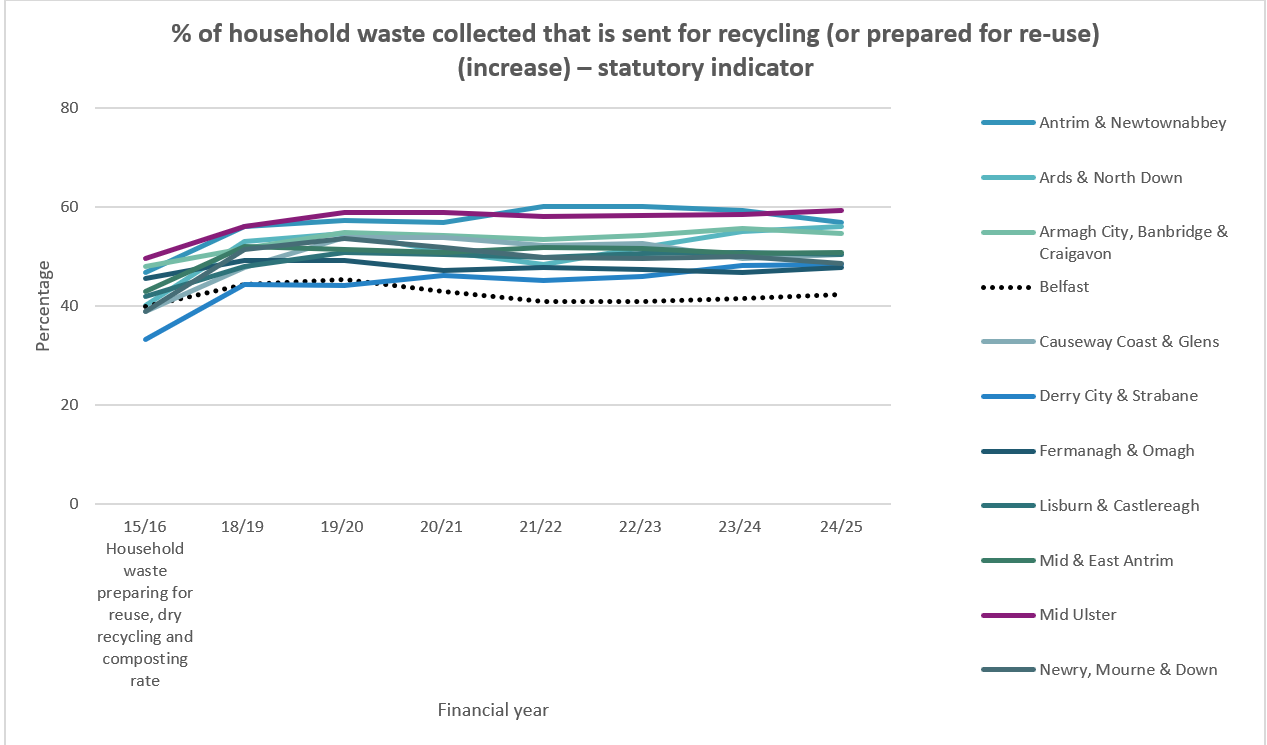
We have maintained a relatively consistent household recycling rate since the reform of Local Government in 2015-2016. There has been an overall reduction in recycling in Belfast since 2018-2019, plateauing at approximately 41 per cent over the last three years. However, Belfast’s recycling rate improved by just over 0.5 per cent between 2023-2024 and 2024-2025. We have a range of ongoing local and regional programmes to change behaviour and increase opportunities to reuse and recycle such as school education visits, pilot street recycling schemes and circular economy projects.
Percentage of household waste collected and sent for recycling (or prepared for re-use) by each council in Northern Ireland between 2015 and 2025 is shown in this table:
| Council area or organisation | 2015-2016 (per cent) | 2018-2019 (per cent) | 2019-2020 (per cent) | 2020-2021 (per cent) | 2021-2022 (per cent) | 2022-2023 (per cent) | 2023-2024 (per cent) | 2024-2025 (per cent) |
|---|---|---|---|---|---|---|---|---|
| Belfast | 40 | 44.4 | 45.4 | 43 | 41 | 40.8 | 41.6 | 42.4 |
| Antrim and Newtownabbey | 46.8 | 56.1 | 57.3 | 56.9 | 60.2 | 60.1 | 59.4 | 56.9 |
| Ards and North Down | 40.2 | 53.1 | 54.7 | 51 | 48.3 | 51.9 | 55.1 | 56.1 |
| Armagh, Banbridge and Craigavon | 48 | 51.6 | 54.8 | 54.3 | 53.5 | 54.2 | 55.6 | 54.6 |
| Causeway Coast and Glens | 38.8 | 47.7 | 53.8 | 53.9 | 52.3 | 52.7 | 49.6 | 50.4 |
| Derry City and Strabane | 33.3 | 44.3 | 44.2 | 46.1 | 45.1 | 46 | 48.2 | 48.4 |
| Fermanagh and Omagh | 45.5 | 49.3 | 49.1 | 47.3 | 47.7 | 47.5 | 46.7 | 47.7 |
| Lisburn and Castlereagh | 41.9 | 48.1 | 50.8 | 49.7 | 49.7 | 50.5 | 50.9 | 50.4 |
| Mid and East Antrim | 42.9 | 52 | 51.4 | 51.9 | 51.7 | 50.7 | 50.7 | 50.8 |
| Mid Ulster | 49.6 | 56 | 58.8 | 58.2 | 58.4 | 58.6 | 58.6 | 59.3 |
| Newry, Mourne and Down | 38.9 | 51.4 | 53.7 | 49.8 | 49.8 | 49.6 | 50.1 | 48.7 |
| Northern Ireland | 42.2 | 50 | 51.9 | 50.1 | 50.1 | 50.7 | 51.1 | 51 |
During 2024-2025, the highest recycling rate was recorded in Mid Ulster, with the lowest in Belfast. Seven out of the 11 councils improved their recycling rates compared to the preceding year, including Belfast. Four councils, including Belfast, were below the Northern Ireland recycling rate, and the target that was set in the Northern Ireland Waste Management Strategy to achieve 50 per cent recycling by 2020.
All councils are still some distance from achieving the target set in the Climate Change Act (Northern Ireland) 2022 of recycling at least 70 per cent of waste by 2030.
Graph showing percentage of household waste collected for recycling or prepared for re-use by councils in Northern Ireland between 2015 and 2025
Biodegradable waste to landfill
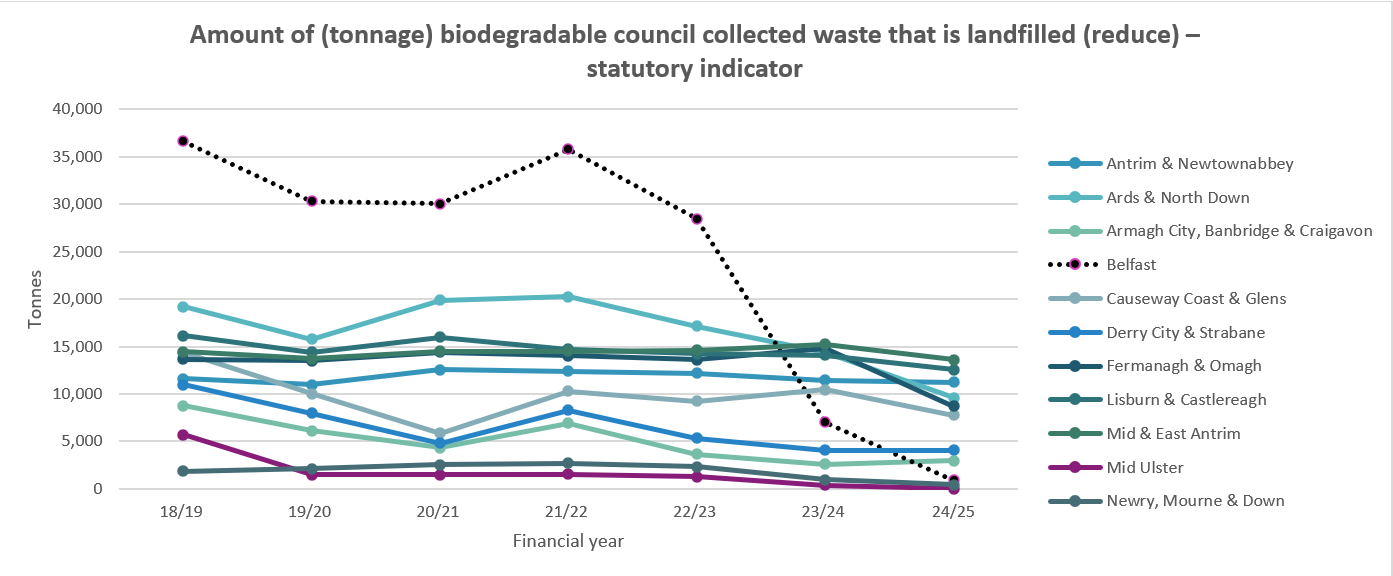
Most councils are reducing the amount of biodegradable waste that is landfilled with a reduction from 218,898 tonnes in 2015-2016 to 71,828 tonnes in 2024-2025. After the award of the new interim residual waste treatment contract which involves the treatment of all residual waste, and none sent directly to landfill, Belfast showed a distinct improvement by reducing biodegradable waste to landfill from 45,231 tonnes in 2015-2016 to 907 tonnes in 2023-2024 and a further 375 tonnes this year.
Amount of biodegradable council-collected waste in tonnes that was landfilled by each council between 2018 and 2025 is shown in this table:
| Council area or organisation | 2018-2019 | 2019-2020 | 2020-2021 | 2021-2022 | 2022-2023 | 2023-2024 | 2024-2025 |
|---|---|---|---|---|---|---|---|
| Belfast | 36,658 | 30,299 | 30,071 | 35,783 | 28,444 | 7,036 | 907 |
| Antrim and Newtownabbey | 11,622 | 10,988 | 12,540 | 12,369 | 12,161 | 11,467 | 11,218 |
| Ards and North Down | 19,186 | 15,762 | 19,873 | 20,262 | 17,124 | 14,413 | 9,584 |
| Armagh, Banbridge and Craigavon | 8,771 | 6,104 | 4,339 | 6,919 | 3,635 | 2,580 | 2,979 |
| Causeway Coast and Glens | 14,356 | 10,004 | 5,861 | 10,278 | 9,232 | 10,418 | 7,751 |
| Derry City and Strabane | 10,974 | 7,964 | 4,802 | 8,299 | 5,310 | 4,076 | 4,071 |
| Fermanagh and Omagh | 13,677 | 13,473 | 14,410 | 14,026 | 13,579 | 14,773 | 8,715 |
| Lisburn and Castlereagh | 16,108 | 14,373 | 15,967 | 14,737 | 14,240 | 14,099 | 12,544 |
| Mid and East Antrim | 14,444 | 13,684 | 14,508 | 14,495 | 14,596 | 15,262 | 13,619 |
| Mid Ulster | 5,681 | 1,505 | 1,494 | 1,537 | 1.285 | 369 | 11 |
| Newry, Mourne and Down | 1,846 | 2,131 | 2,538 | 2,685 | 2,319 | 932 | 429 |
| Northern Ireland | 153,323 | 126,286 | 126,404 | 141,390 | 121,925 | 95,425 | 71,828 |
Graph showing amount of biodegradable council-collected waste in tonnes that was landfilled by each council between 2018 and 2025
Council-collected waste
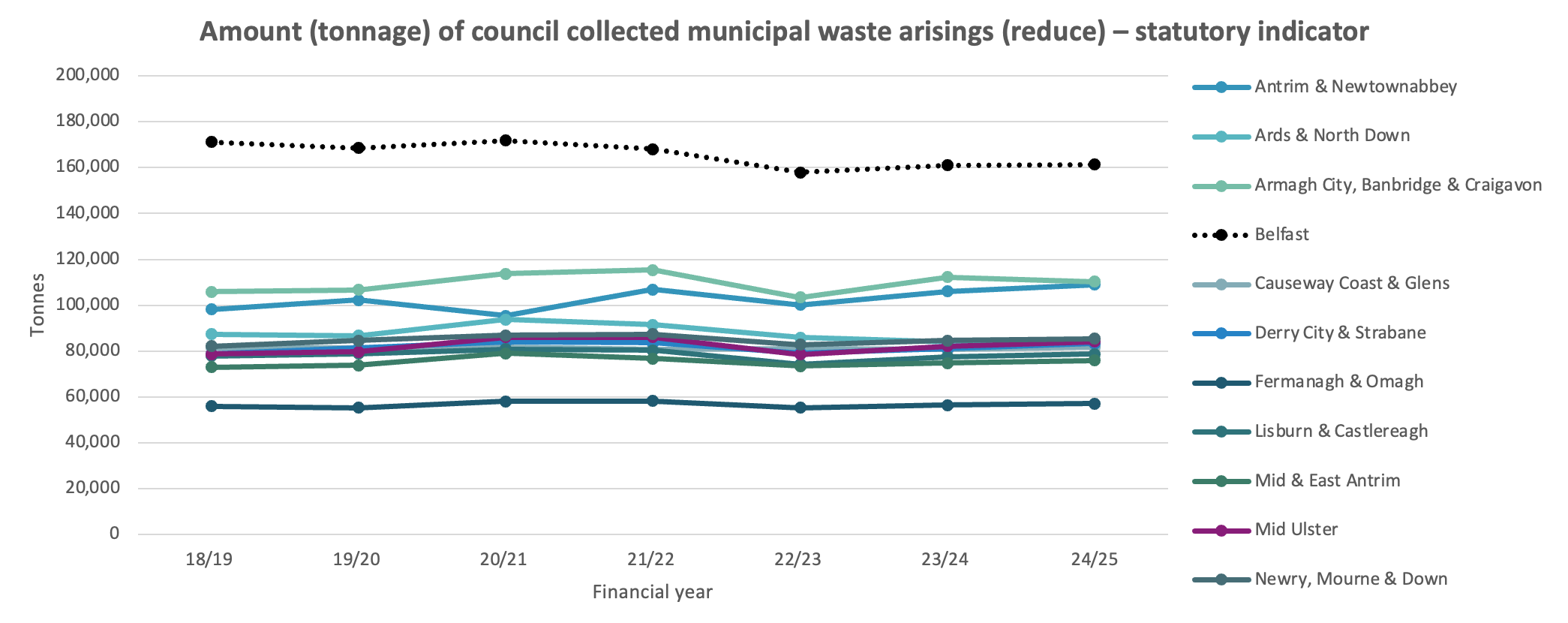
The amount of waste collected by each council broadly reflects population levels within their boundaries. Belfast is historically inclined to have the highest, with Fermanagh and Omagh the lowest. Whilst there was a slight increase in our municipal waste arisings during 2024-2025 for the reasons outlined, there has been an overall reduction in the amount of municipal waste arisings since 2018-2019 (consistent with the majority of other councils) and since the reform of Local Government in 2015-2016. This is despite a population increase of 2.3 per cent (7,811 people) in Belfast since 2015.
Amount of council-collected municipal waste arisings in tonnes for each council between 2015 and 2025 is shown in this table:
| Council area or organisation | 2015-2016 | 2018-2019 | 2019-2020 | 2020-2021 | 2021-2022 | 2022-2023 | 2023-2024 | 2024-2025 |
|---|---|---|---|---|---|---|---|---|
| Belfast | 169,964 | 171,118 | 168,515 | 171,795 | 168,037 | 157,892 | 161,097 | 161,320 |
| Antrim and Newtownabbey | 85,058 | 98,224 | 102,267 | 95,468 | 106,804 | 100,076 | 106,040 | 109,028 |
| Ards and North Down | 99,770 | 87,338 | 86,698 | 93,705 | 91,434 | 85,976 | 83,895 | 83,605 |
| Armagh, Banbridge and Craigavon | 102,957 | 105,828 | 106,742 | 113,712 | 115,327 | 103,379 | 112,335 | 110,210 |
| Causeway Coast and Glens | 78,363 | 81,432 | 81,279 | 81,611 | 80,884 | 81,063 | 80,596 | 161,320 |
| Derry City and Strabane | 70,901 | 78,660 | 81,304 | 83,989 | 83,540 | 79,114 | 81,027 | 81,695 |
| Fermanagh and Omagh | 53,963 | 55,931 | 55,224 | 58,108 | 58,211 | 55,362 | 56,521 | 83,236 |
| Lisburn and Castlereagh | 70,480 | 77,861 | 78,905 | 80,846 | 80,299 | 74,211 | 77,617 | 57,134 |
| Mid and East Antrim | 75,541 | 73,032 | 73,797 | 78,986 | 76,689 | 73,433 | 74,842 | 78,739 |
| Mid Ulster | 77,701 | 78,672 | 79,645 | 86,049 | 86,085 | 78,589 | 82,075 | 75,880 |
| Newry, Mourne and Down | 84,459 | 82,136 | 84,610 | 86,900 | 87,328 | 82,842 | 84,636 | 84,181 |
| Northern Ireland | 969,157 | 990,233 | 998,985 | 1,031,169 | 1,034,637 | 971,936 | 1,000,681 | 1,010,410 |
Graph showing amount of council-collected municipal waste arisings by councils in Northern Ireland between 2018 and 2025
What other actions were completed to achieve improvement objective 4: Our planet?
Through our Corporate Plan 2025-2028 and supporting Corporate Delivery Plan 2025-2026 we also:
- used electricity for council properties from renewable energy sources thanks to our contract with local energy supplier 3T Power.
- reduced energy consumption through our GLL Partnership by a further 10 per cent in 2025 compared to 2024.
- offered 110 Belfast Bikes free to social enterprises, co-operatives, and charities across the city.
- introduced 100 state-of-the-art public e-bikes to the Belfast Bikes fleet for the first time, alongside updated pedal bikes.
- welcomed the births of a number of species at Belfast Zoo, that are endangered in the wild as part of international breeding programmes designed to protect the future of wildlife – including a Colombian spider monkey, a rare François’ langur and a cotton‑top tamarin.
- established five community orchards across the city, transforming urban spaces into 'edible landscapes'.
- achieved 24 Green Flag accreditations for our open space sites across the city.
- secured £850,514 in funding from The National Lottery Heritage Fund to support a major new project aimed at strengthening connections between people and nature across the city.
- leveraged £60,000 through Making Space for Nature to deliver enhancements in parks, open spaces, and community green assets.
- delivered 2,000 community environmental sessions, 365 school sessions and 125 community clean-ups.
What are next steps for improvement objective 4: Our planet?
To meet the evolving needs of the city, we have broadened the scope of our planet objective to align with the Belfast Agenda Planet objective. This improvement objective features in the Performance Improvement Plan 2026-2027 as:
- We will create a sustainable, nature-positive city.
Our planet continues to feature as a strategic theme of the refreshed Belfast Agenda and is a key priority in our Corporate Plan 2025-2028.
What was the impact of improvement objective: 4 Our planet?
UPSURGE Lower Botanic Gardens demonstrator
We delivered the Lower Botanic Gardens Demonstrator initiative in conjunction with Queen's University Belfast (QUB), Friends of the Field and Friends of Botanic. To date we have:
- invested £0.73million in UPSURGE
- provided one demonstrator site at Lower Botanic, and
- planted over 1,500 wetland species
- agreed four satellite sites for 2026 to 2027 .
Key achievements for improvement objective 4
How well did we do?
- Community garden planted and education space established
- Living lab space established as a soil research testing area
- Grassland and wetland areas created to encourage biodiversity and restore habitats
- Royal Horticultural Society growing space established
- Research Garden established by QUB with two ongoing trials on the site
- Innovative research including monitoring air quality and environmental data
- New entrance and bus stop installed at the site for better connectivity
Is anyone better off?
- Enriched urban biodiversity through wildflowers, woodland, and habitat restoration
- Increased community access to green space and sustainable food growing
- Enhanced community integration through the transformed shared urban space
- Strengthened community skills, learning, and engagement in sustainability
- Enhanced community resilience to flood risk and heat stress risk
- Enhanced health and wellbeing outcomes through a greener environment
Lower Botanic is a real test bed for experimenting and learning about how we adapt our green spaces to make them more resilient as climate change impacts increase across our city.
Adaptation and Resilience Advisor
The community garden is much more than a weekend hobby. It will serve as a platform for the public to engage with sustainable food growing, learn about biodiversity and promote environmental protection.
Friends of the Field
Improvement objective 5: Our economy
Did we achieve improvement objective 5: Our economy?
Achieved. We stimulated inclusive growth and innovation, helped businesses to start up and grow, and created opportunities for more and better jobs and employment.
Belfast Agenda outcome for improvement objective 5
Belfast is a place where everyone benefits from a thriving and prosperous economy.
Corporate Plan themes and priorities for improvement objective 5
Our economy: Creating inclusive and sustainable growth, learning, and opportunity
Six actions for improvement objective 5
- 100 per cent of actions were achieved or completed
Nine performance indicators (target) for improvement objective 5
- 8 (89 per cent) were on target or exceeded target (within 1 per cent or better)
- 1 (11 per cent) was adrift of target (more than 5 per cent)
Nine performance indicators (trend) for improvement objective 5
- 7 (78 per cent) showed positive change
- 2 (22 per cent) showed negative change
What did we do to achieve improvement objective 5: Our economy?
- Achieved: we worked with the Enterprise Support Service to deliver Go Succeed to increase the number of new business starts.
- Achieved: we delivered employment and upskilling academies in priority sectors in line with industry demand.
- Achieved: we delivered the Smart Belfast urban innovation programme to enhance Belfast’s capacity for digital innovation.
- Achieved: we delivered an enhanced Learning City Festival to promote and encourage lifelong learning for people of all ages across Belfast.
- Achieved: we extended the delivery of Belfast Business Promise (BBP) initiative to support the provision of good jobs and a sustainable local economy.
- Achieved: we supported our suppliers by helping business cashflow through the prompt payment of invoices.
How we measured success for improvement objective 5: Our economy
| Measure of success | 2021-2022 | 2022-2023 year-end actual | 2023-2024 year-end actual | 2024-2025 year end actual | 2025-2025 year-end target | 2025-2026 year end actual | Trend (since baseline year) | Commentary (including rationale if negative or adrift) |
|---|---|---|---|---|---|---|---|---|
| Completing 325 business plans to promote business start-up and job promotion (statutory indicator) | 514 | 472 | 263 | 196 | 325 | 328 | Worsening | Target exceeded |
| Supporting 75 per cent of participants to move into a positive outcome from an employment or upskilling academy | Not applicable | 79 per cent | 75.8 per cent | 82 per cent | 75 per cent | 66 per cent | Worsening | In total, 296 of the 448 participants to complete an academy during the last 12 months have already secured a job or better job (66 per cent). Securing employment is an ongoing process that continues for a period of six months where an aftercare service is provided to participants after completing their academy. This is a ‘state of play’ and will continually increase over the next six months. We are on track to achieve a minimum of 75 per cent into-work rate. |
| Supporting 425 small and medium-sized enterprises (SMEs) to engage in digital innovation | Not applicable, new for 2024-2025 | Not applicable, new for 2024-2025 | Not applicable, new for 2024-2025 | 433 | 425 | 430 | Improving | Exceeded target by 1.18 per cent. |
| Awarding £600,000 of funding to organisations to engage in digital innovation | Not applicable | Not applicable | Not applicable | Not applicable | £600,000 | £600,000 | Improving | This funding was attached to two mature programmes that closed in 2026 (Augment the City and Department for Science, Innovation and Technology (DSIT) 5G). New funding will be issued in 2026-2027 via the £4.3 million Contracts for Innovation, £5 million adoption programme and the £5 million AI Entrepreneurial Fund. These funds will have a staggered launch over 24 months. |
| Percentage of participants who agreed they felt more aware of the learning providers and opportunities across the city following their attendance at a Learning City festival event | Not applicable | Not applicable | Not applicable | Not applicable | Establish baseline | 73 per cent | Improving | Baseline established in quarter 1 as part of a revised approach to evaluating the programme. |
| Supporting 10 businesses (existing Belfast Business Promise (BBP) members) to improve their recognition level (reaching Member or Ambassador status) | Not applicable | Not applicable | Not applicable | Not applicable | 10 | 42 | Improving | Exceeded target, 80 organisations live, 33 supporters, 29 members, 13 ambassadors, 269 pledges awarded. |
| Producing four good practice case studies to highlight the BBP journey and inclusive growth in practice | Not applicable | Not applicable | Not applicable | Not applicable | 4 | 5 | Improving | Target exceeded. Good news stories and best practice case studies will be captured throughout the transitional phase of the programme to highlight further successes of 2025-2026. |
| Paying 90 per cent of invoices within 30 calendar days | 94 per cent | 92 per cent | 93 per cent | 89.25 per cent | 90 per cent | 96 per cent | Improving | Target exceeded by 7 per cent. We paid suppliers quicker this year than last year. |
| Paying 80 per cent of invoices within 10 working days | 81.29 per cent | 81.31 per cent | 81.05 per cent | 76.95 per cent | 80 per cent | 88 per cent | Improving | Target exceeded by 10.4 per cent. We paid suppliers quicker this year than last year. |
How does our business start-up and growth activity compare with other councils?
Business start-up and growth activity (statutory performance indicator): number of business plans developed (2025 -2026 data is provisional, subject to final verification).
The Go Succeed programme has been delivered in collaboration by all 11 councils since September 2017 (previously Go For It). Together we have supported 13,555 entrepreneurs to produce business plans and in doing so created 8,134 jobs. Nine (82 per cent) of eleven councils met their jobs promotion target during 2025-2026. Since 2018-2019, Belfast City Council has delivered the greatest number of business plans and jobs, representing 15 per cent of all programme business plans and promoted the same proportion of programme jobs.
Number of business plans developed by each council between 2021 and 2026 is shown in this table:
| Council area or organisation | 2021-2022 | 2022-2023 | 2023-2024 | 2024-2025 | 2025-2026 | Total business plans developed by each council 2021-2026 |
|---|---|---|---|---|---|---|
| Belfast | 514 | 472 | 263 | 269 | 547 | 2,065 |
| Antrim and Newtownabbey | 162 | 172 | 91 | 238 | 292 | 955 |
| Ards and North Down | 211 | 166 | 106 | 194 | 298 | 975 |
| Armagh, Banbridge and Craigavon | 386 | 353 | 173 | 204 | 377 | 1,493 |
| Causeway Coast and Glens | 256 | 213 | 110 | 220 | 291 | 1,090 |
| Derry City and Strabane | 238 | 240 | 118 | 265 | 314 | 1,175 |
| Fermanagh and Omagh | 309 | 308 | 147 | 204 | 231 | 1,199 |
| Lisburn and Castlereagh | 213 | 187 | 103 | 199 | 268 | 970 |
| Mid and East Antrim | 181 | 206 | 110 | 231 | 267 | 995 |
| Mid Ulster | 269 | 278 | 134 | 151 | 308 | 1,140 |
| Newry, Mourne and Down | 356 | 305 | 128 | 316 | 393 | 1,498 |
| Total | 3,095 | 2,900 | 1,483 | 2,491 | 3,586 | 13,555 |
Number of jobs promoted through the Go Succeed programme (statutory performance indicator) (provisional data 2025 and 2026 is shown in this table:
Number of jobs promoted through the Go Succeed programme (formerly Go For It) (statutory indicator) by each council between 2021 and 2026 is shown in this table (data for 2025-2026 is provisional, subject to final verification).
| Council area | 2021-2022 | 2022-2023 | 2023-2024 | 2024-2025 | 2025-2026 | Total jobs promoted by each council 2021-2026 |
|---|---|---|---|---|---|---|
| Belfast | 308 | 283 | 158 | 161 | 328 | 1,238 |
| Antrim and Newtownabbey | 97 | 103 | 55 | 143 | 175 | 573 |
| Ards and North Down | 127 | 100 | 64 | 116 | 179 | 586 |
| Armagh, Banbridge and Craigavon | 232 | 212 | 104 | 122 | 226 | 896 |
| Causeway Coast and Glens | 154 | 128 | 66 | 132 | 175 | 655 |
| Derry City and Strabane | 143 | 144 | 71 | 159 | 188 | 705 |
| Fermanagh and Omagh | 185 | 185 | 88 | 122 | 139 | 719 |
| Lisburn and Castlereagh | 128 | 112 | 62 | 119 | 161 | 582 |
| Mid and East Antrim | 109 | 124 | 66 | 139 | 160 | 598 |
| Mid Ulster | 161 | 167 | 80 | 91 | 185 | 684 |
| Newry, Mourne and Down | 214 | 183 | 77 | 190 | 236 | 900 |
| Total | 1,857 | 1,740 | 890 | 1,495 | 2,152 | 8,134 |
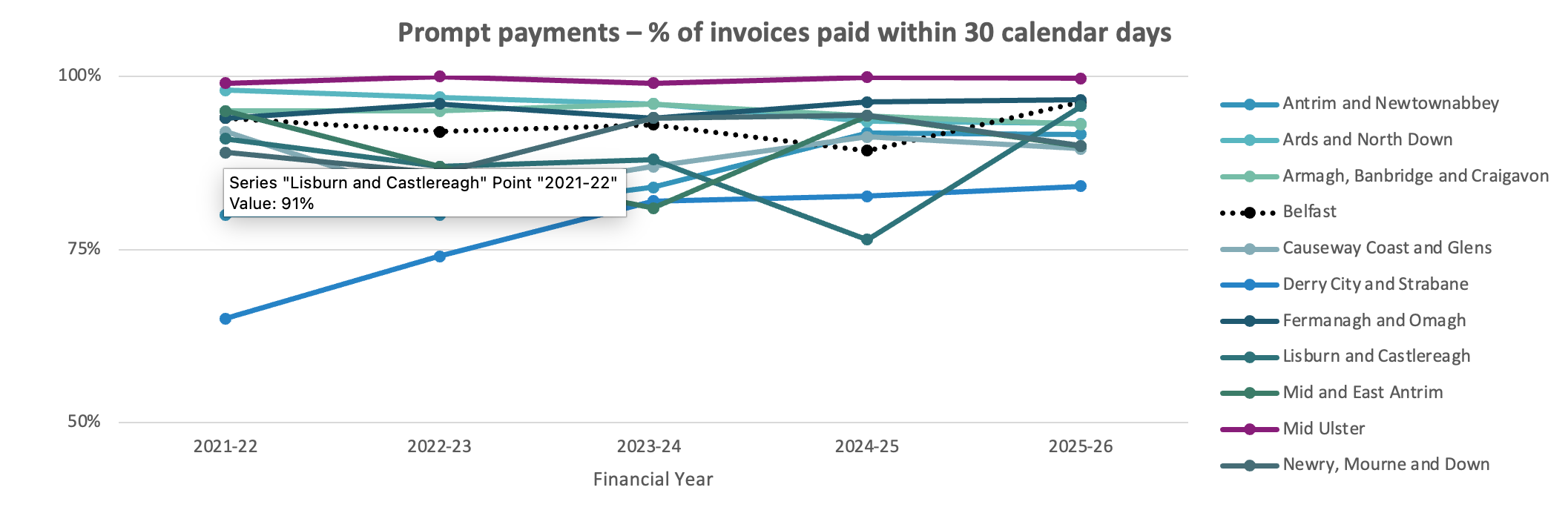
Performance benchmarking: prompt payments
Prompt payment of invoices is an indicator of a healthy organisation with effective internal controls and corporate governance. Prompt payment of invoices is also important to support the cashflow of small and medium-sized enterprises. Therefore, in 2025-2026, we continued to use this as an indicator of how well we are helping small businesses, including social enterprises and co-operatives, to develop and grow.
Percentage of invoices paid within 30 calendar days by each council between 2021 and 2026 is shown in this table:
| Council area | 2021-2022 (per cent) | 2022-2023 (per cent) | 2023-2024 (per cent) | 2024-2025 (per cent) | 2025-2026 (per cent) |
|---|---|---|---|---|---|
| Belfast | 94 | 92 | 93 | 89 | 96 |
| Antrim and Newtownabbey | 80 | 80 | 84 | 92 | 92 |
| Ards and North Down | 98 | 97 | 96 | 94 | 93 |
| Armagh, Banbridge and Craigavon | 95 | 95 | 96 | 94 | 93 |
| Causeway Coast and Glens | 92 | 82 | 87 | 91 | 90 |
| Derry City and Strabane | 65 | 74 | 82 | 83 | 84 |
| Fermanagh and Omagh | 94 | 96 | 94 | 96 | 97 |
| Lisburn and Castlereagh | 91 | 87 | 88 | 76 | 96 |
| Mid and East Antrim | 95 | 87 | 81 | 94 | 90 |
| Mid Ulster | 99 | 100 | 99 | 100 | 100 |
| Newry, Mourne and Down | 89 | 86 | 94 | 94 | 90 |
| Average percentage of prompt payments by 11 councils each year | 90 | 89 | 90 | 91 | 93 |
Graph showing prompt payments: percentage of invoices paid within 30 calendar days by each council between 2021 and 2026
What other actions were completed to achieve improvement objective 5: Our economy?
Through our Corporate Plan 2025-2028 and supporting Corporate Delivery Plan 2025-2026 we also:
- delivered the NI Enterprise Support Service (NIESS) on behalf of 11 councils.
- enabled test trading opportunities for 48 new businesses through our dedicated start up space at St George’s Market
- enabled 928 people to successfully start an employment or upskilling academy:
- 519 people started an employment academy and of those completing, 153 have already secured employment.
- 409 started an upskilling academy and of this total, 143 have already secured a better job.
- 218 participants are still participating in an employment academy and 262 in an upskilling academy.
- delivered the Belfast Learning Festival to promote inclusive access to lifelong learning for people of all ages and backgrounds:
- 65 partners delivered 119 free learning events.
- we awarded £23,548 small grant funding to not-for-profit organisations.
- supported the delivery of the fourth year of the Belfast Region City Deal (BRCD) programme, including these activities during 2025-2026:
- dispersing over £45 million to partners to progress the various projects across the four investment pillars.
- gaining approval for a £2 million BRCD Innovation Centre Collaborative Grants Programme (supported by Invest NI) to encourage small and medium-sized enterprises (SMEs) to engage and collaborate with the BRCD Innovation Centres.
- progressing Belfast Stories, a landmark major tourism anchor in the city centre, to Royal Institute of British Architects (RIBA) design stage 3a.
- progressing £48 million Belfast Rapid Transport Phase 2 project, a major public transport initiative to expand the Glider network.
- delivering the Belfast Region City Deal Innovation Challenge Fund to stimulate innovation.
- Delivered the Belfast Business Promise:
- 80 organisations live (38 Supporters, 29 Members, 13 Ambassadors), with 269 pledges awarded.
- Generated £47 million in social value in 2025 through our leisure partners Greenwich Leisure Limited (GLL).
- applied our Social Value procurement policy to 61 per cent of awarded council contracts.
- extended Sunday trading hours during Fleadh Cheoil na hÉireann.
What are next steps for improvement objective 5: Our economy?
We will continue to progress this improvement objective in the Performance Improvement Plan 2026-2027:
- We will stimulate inclusive growth and innovation, help businesses to start up and grow and create opportunities for more and better jobs and employment.
Our economy continues to feature as a strategic theme of the refreshed Belfast Agenda and is a key priority in our Corporate Plan 2025-2028.
What was the impact of improvement objective 5: Our economy?
Go Succeed, NI Business Support
How well did we do?
- £9.2 million of the UK Shared Prosperity Fund secured to deliver the NI Enterprise Support Service
- Over 10,000 hours of one-to-one mentoring support
- £4.53 million secured for future delivery
Is anyone better off?
- 873 Belfast individuals and entrepreneurs supported through start-up activity
- 434 Belfast businesses supported through business growth activity
- 54 organisations supported to start or grow social enterprises and co-operatives via our dedicated Go Social support
- 1,258 individuals engaged through a range of community outreach activities providing them with tools to overcome barriers to take positive steps to starting a business
- Over £285,000 Go Succeed grants awarded to 27 Belfast businesses to remove barriers to growth
- £90k Social Incentive Fund awarded to 17 social enterprises to support growth goals
- 31 SMEs supported to access the Digital Transformation Flexible Fund to help stimulate digital innovation
- 55 per cent of participants were female
Through Go Succeed, we received some incredible mentorship providing a real crash course in business. Having that guidance helped us to realise some of the mistakes that we were making and better understand our structures and have a more solid foundation for the business for the years ahead.
Company owner, 1620 Audio
Participating in Go Succeed has been a valuable experience for our company. We have felt really supported by the entire team… it will help us to create a new website and develop our product further.
Company owner, Understanding Me – a Learning Me App
Improvement objective 6: Compassionate city
Did we achieve improvement objective 6?
Achieved. We supported our most vulnerable people to make Belfast a more caring, safe and inclusive city.
Belfast Agenda outcome for improvement objective 6
Belfast is a place where everyone fulfils their potential.
Corporate Plan themes and priorities for improvement objective 6
- Compassionate city – Making Belfast a welcoming, caring, and inclusive city – leaving no-one behind
- Inclusive growth and anti-poverty
Five actions for improvement objective 6
- 100 per cent of actions were achieved or completed
Seven performance indicators (target) for improvement objective 6
- 7 (100 per cent) were on target or exceeded target (within 1 per cent or better)
Seven performance indicators (trend) for improvement objective 6
- 7 (100 per cent) showed positive change
What did we do to achieve improvement objective 6: Compassionate city?
- Achieved: we delivered local community actions plans as part of the PEACEPLUS programme, to fund community activities and infrastructure project that help build peace and reconciliation in Belfast.
- Achieved: we established an anti-poverty network in Belfast to support and facilitate a co-ordinated approach to tackling poverty across the city.
- Partially achieved: we extended delivery of the Hardship Programme to ensure that support is available for those people most impacted by poverty and the cost-of-living crisis.
- Achieved: we delivered a programme to help end violence against women and girls (EVAWG).
- Achieved: we progressed delivery of up to five capital projects across the city as part of the PEACEPLUS Local Action Plan to promote inclusive and shared spaces across Belfast.
How we measured success for improvement objective 6: Compassionate city
| Measure of success | 2021-2022 year end actual | 2022-2023 year-end actual | 2023-2024 year-end actual | 2024-2025 year end actual | 2025-2026 year-end target | 2025-2026 year end actual | Trend (since baseline year) | Commentary (including rationale if negative or adrift) |
|---|---|---|---|---|---|---|---|---|
| Delivering 10 local community action plans (including relevant peace monitoring information) | Not applicable | Not applicable | Not applicable | Not applicable | 10 | 16 | Improving | Target achieved in quarter 2 and exceeded by 60 per cent. There were 16 local community action plans delivered linked to PEACEPLUS under three thematic themes: Local Community Regeneration and Transformation (CRT); Thriving and Peaceful Communities (TPC) includes action plans (TPC) Celebrating Cultures and Diversity (CCD). |
| Establishing the Anti-poverty Network | Not applicable | Not applicable | Not applicable | Not applicable | 1 | 1 | Improving | Held on 5 February 2026 with over 100 attendees. There is a commitment to hold at least one event per year. |
| Delivering £1.1 million of Hardship Programme funding | Not applicable | Not applicable | Not applicable | Not applicable | 1,100,000 | 1,100,000 | Improving | £1.1 million paid, supporting over 56,000 people |
| Awarding and delivering £255,000 as part of an open call small grants programme as part of the Ending Violence Against Women and Girls (EVAWG) programme | Not applicable, new for 2025-2026 | Not applicable, new for 2025-2026 | Not applicable, new for 2025-2026 | Not applicable, new for 2025-2026 | £255,000 | £592,537 | Improving | Target exceeded as The Executive Office (TEO) provided additional funding: Tranche 1 £82,726 (19 awards) Tranche 2: £236,580 (18 awards) Tranche 3: £273,231 (13 awards) Total: £592.537 (50 awards) |
| Administering £1.2 million of Regional Change Funding to eight EVAWG expert organisations | Not applicable, new for 2025-2026 | Not applicable, new for 2025-2026 | Not applicable, new for 2025-2026 | Not applicable, new for 2025-2026 | £1,200,000 | £1,200,000 | Improving | £1.2 million awarded in quarter 2 |
| Engaging a minimum of 2,000 children and young people as part of the EVAWG programme | Not applicable, new for 2025-2026 | Not applicable, new for 2025-2026 | Not applicable, new for 2025-2026 | Not applicable, new for 2025-2026 | 2,000 | 7,297 | Improving | Target exceeded. EVAWG engaged 7,297 children and young people from 1 April 2025 to 31 March 2026 (8,833 over 15-month programme) |
| Progressing up to five capital projects under PEACEPLUS Local Action Plan (Sanctuary Theatre, Distillery Street Redevelopment Project, Annadale Open Space, Reconnected Belfast, and LGBTQIA+ Hub) | Not applicable | Not applicable | Not applicable | Not applicable | 5 | 5 | Improving | Five capital projects progressed:
|
What other activities were completed for improvement objective 6: Compassionate city?
Through our Corporate Plan 2025-2028 and supporting Corporate Delivery Plan 2025-2026:
- we supported inclusive growth by creating 63 work placements and 6 apprenticeships (including inclusive apprenticeships), as well as facilitating 27 pre-recruitment training programme placements.
- our leisure partners GLL were highly commended in the Social Value category at the Belfast Business Awards.
- City Hall was awarded an 'Autism Impact Award' from Autism NI in recognition of the work undertaken to make the venue a more autism-friendly environment for our visitors.
- we agreed an approach towards Area Based Community Planning, including a £1.5 million Community Ownership Fund and £500,000 to support community partners in developing area-based community plans.
What are next steps for improvement objective 6: Compassionate city?
We will continue to progress this improvement objective in the Performance Improvement Plan 2026-2027:
- We will support our most vulnerable people to make Belfast a more caring, safe and inclusive city.
Compassionate city continues to feature as a strategic theme of the refreshed Belfast Agenda and is a key priority in our Corporate Plan 2025-2028.
What was the impact of improvement objective 6: Compassionate city?
Building peace and good relations
PEACEPLUS: Local Community Action Plan and Reconnected Belfast
- £15.1million secured to deliver the Belfast PEACEPLUS Local Community Action Plan
- 16 projects across three strategic themes
- Five capital projects progressed
- 3,020 participants
- 62 per cent of participants are women and girls
- 62 per cent of participants are ethnic minorities
- 75 per cent increased understanding of other cultures, identities or opinions
- 76 per cent made new connections with different identities
- £11.8 million secured for Reconnected Belfast to regenerate Waterworks and Alexandra Park
We are delighted to deliver this important programme on behalf of Belfast City Council as part of their Local Community Action Plan. At its heart, the Community Empowerment Programme is about enabling people to lead, to respond to challenges in their areas, strengthen connections between communities, and bring about lasting, positive change.
NICVA
Good Relations
- 48 projects supported through open call and small grants
- £688,562 allocated to Good Relations programmes
- 6,039 participants engaged
- 69 per cent felt they had a better attitude to different religious backgrounds
- 66 per cent felt they had a better attitude towards those from a different ethnic or racial background
Belfast has given me so much: friends, a community, a purpose. I love working with different organisations to support people here. But I’ve also faced challenges as a refugee. Some people judge before they know me, assuming I don’t belong. That’s why I support the ‘This is Me’ campaign.
Participant in This is Me project, delivered by Donegall Pass Community Enterprises
