

Performance improvement duty
Performance improvement under the Local Government Act 2014
Part 12 of the Local Government Act (Northern Ireland) 2014 provides the framework to support continuous improvement for all councils. The Act requires councils to measure how well services perform and publish an annual self-assessment report by 30 September each year and include:
1. An assessment of its performance during a financial year:
- in discharging its duty to make arrangements to secure continuous improvement
- in meeting its improvement objectives which are applicable to that year
- by reference to the statutory performance indicators and self-imposed indicators which are applicable to that year.
2. An assessment of its performance in exercising its functions during a financial year as compared with:
- its performance in previous financial years, and
- so far as reasonably practicable, the performance during that and previous financial years of other councils.
What is improvement?
In accordance with the Act and accompanying guidance, improvement means continuously improving over time - enhancing the sustainable quality of life and environment for ratepayers and communities. It is not limited to increasing service outputs or improving efficiency.
We regularly review our improvement objectives to make sure they reflect local needs, priorities, and available resources. We align our improvement objectives to bring about improvement in at least one of the specified aspects of improvement as defined in section 86 of the Act:
- Strategic effectiveness
- Service quality
- Service availability
- Fairness
- Sustainability
- Efficiency
- Innovation
Arrangements to secure continuous improvement
The council’s improvement framework
The council has clear processes in place to help us improve services and monitor performance.
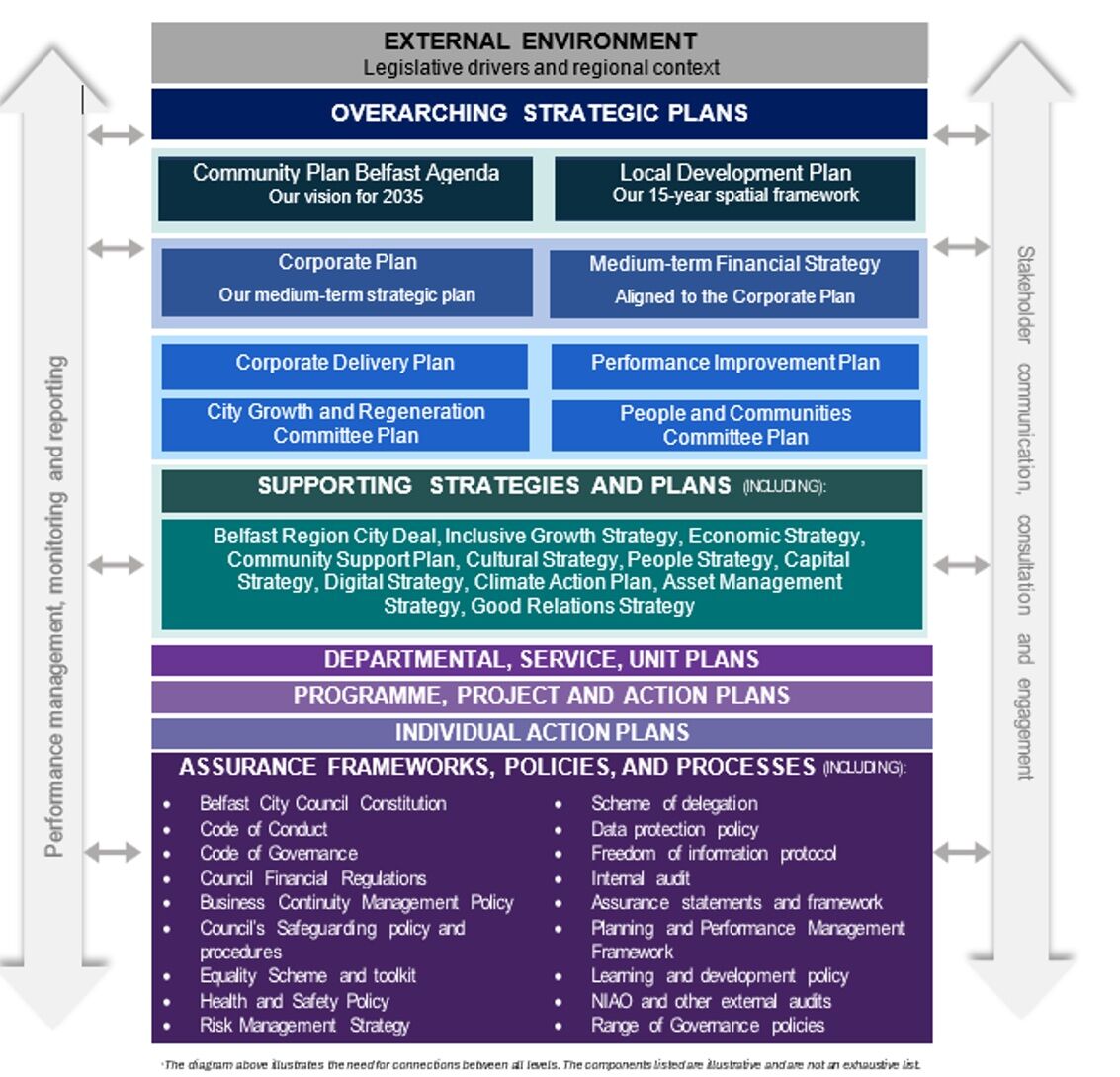
The council’s improvement framework explains how the council works and brings together its priorities, ambitions, and outcomes for Belfast. It links the overarching strategic outcomes, ambitions and priorities set out in key strategies and plans to the annual works plans of our employees, making clear the contribution each employee makes to achieving the city’s strategic outcomes.
It helps ensure that all parts of the council work towards the same priorities and goals, known as the ‘golden thread.’ We keep the improvement framework under review to support our duty to improve.
Belfast City Council planning framework
Strategic plans, supporting plans and assurance arrangements.
External environment
- Legislative drivers and regional context
Overarching strategic plans
- Community Plan Belfast Agenda, our vision for 2035
- Local Development Plan, our 15-year spatial framework
- Corporate Plan, our medium-term strategic plan
- Medium-term Financial Strategy, aligned to the Corporate Plan
- Corporate Delivery Plan
- Performance Improvement Plan
- City Growth and Regeneration Committee Plan
- People and Communities Committee Plan
Supporting strategies and plans
- Belfast Region City Deal
- Inclusive Growth Strategy
- Economic Strategy
- Community Support Plan
- Cultural Strategy
- People Strategy
- Capital Strategy
- Digital Strategy
- Climate Action Plan
- Asset Management Strategy
- Good Relations Strategy
Further plans
- Departmental,service, unit plans
- Programme, project and action plans
- Individual action plans
Assurance frameworks, policies and processes
- Belfast City Council Constitution
- Code of Conduct
- Code of Governance
- The council's Financial Regulations
- Business Continuity Management Policy
- The council’s Safeguarding policy and procedures
- Equality Scheme and toolkit
- Health and Safety Policy
- Risk Management Strategy
- Scheme of delegation
- Data protection policy
- Freedom of information protocol
- Internal audit
- Assurance statements and framework
- Planning and Performance Management Framework
- Learning and development policy
- NIAO and other external audits
- Range of governance policies
Across all levels
- Performance management, monitoring and reporting
- Stakeholder communication, consultation and engagement
Figure 1 illustrates the need for connections between all levels. The list of components is illustrative and is not exhaustive.
Measuring performance and improvement
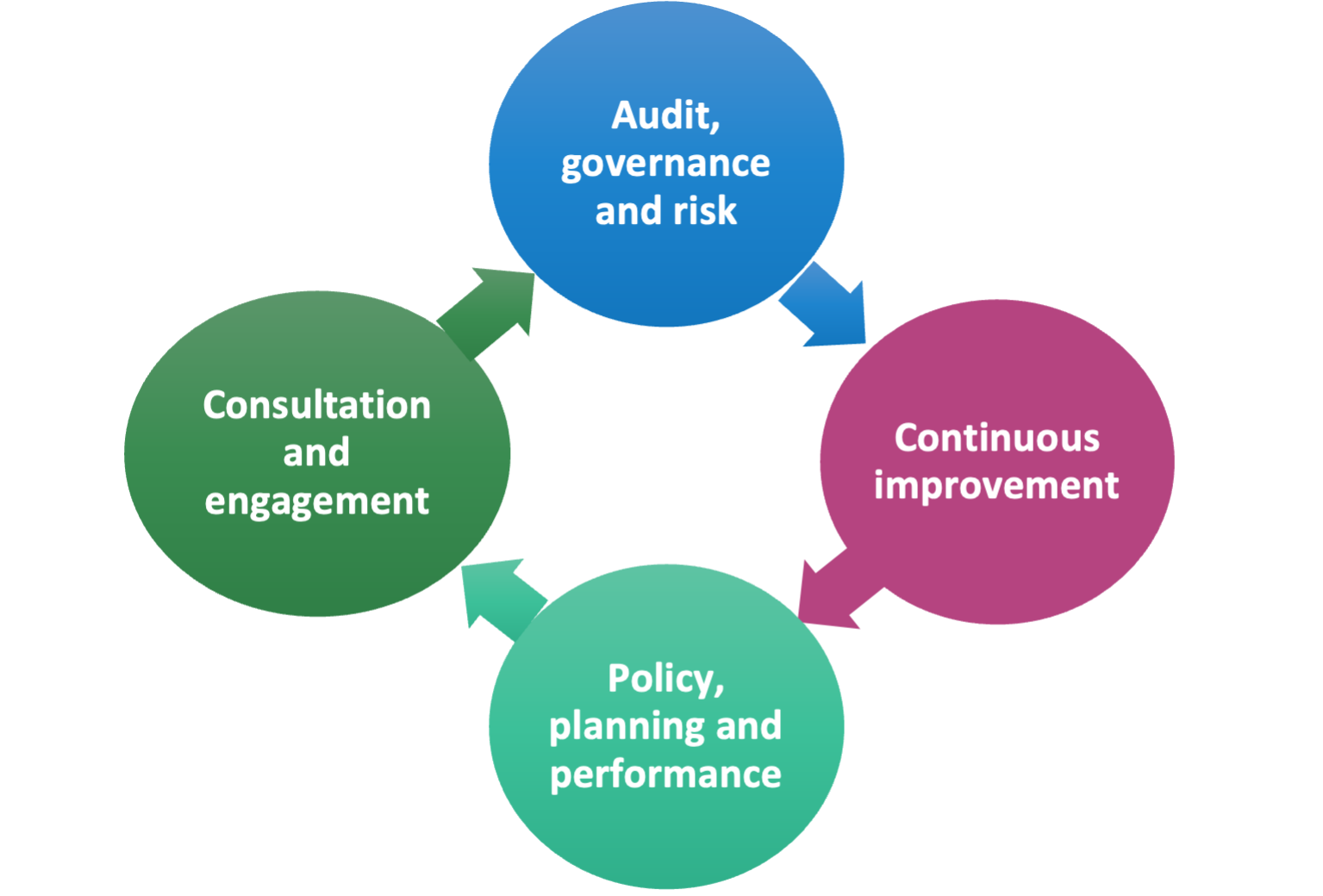
The council continues to enhance, implement, and embed arrangements that support continuous improvement in how we deliver our functions, through:
Audit governance and risk
Our performance is audited externally by the Northern Ireland Audit Office (NIAO) and proposals for improvement implemented. The council’s Corporate Management Team (CMT), Audit Assurance Board and Audit and Risk Panel also monitor performance. Our internal audit service, committee, and the full council review performance regularly.
We agree an annual audit plan and monitor actions arising from it through the Audit and Risk Panel to improve our internal control environment.
We manage and monitor risk that could affect the delivery of our objectives through through the council's Risk Management Strategy. We monitor risks at strategic, operational and project level and take action when needed to adapt how we work and maintain service delivery.
Continuous improvement
We have a dedicated continuous improvement team that leads and supports improvement projects, organisational change and service re-design across the council.
Policy, planning and performance
We develop corporate policies and programmes are developed across the organisation in response to emerging priorities. We monitor and report on these through cross-departmental groups, management teams, and boards, and regularly report progress to the relevant committee.
We monitor progress against our key strategies and plans through regular reports to CMT and relevant committees. We assess and evaluate our performance through published documents including the Annual Accounts, Annual Audit Letter, Annual Performance Assessment and Annual Statement of Governance.
We are finalising our corporate planning and performance management framework to strengthen our continuous improvement journey.
Stakeholder communication, consultation, and engagement
The council uses a range of communication methods to engage with stakeholders, seek views on key plans and priorities and keep them informed about our services and initiatives.
Monitoring, reporting and governance arrangements
Our monitoring and reporting arrangements help us manage performance, make informed decisions and remain accountable. They provide management teams and elected members with assurance that our governance arrangements are robust. This helps us remain open, accountable, and focused on improving services. The council’s governance framework uses a traditional committee structure, with full council and eight standing committees. The full council, which consists of all 60 elected representatives, is the main decision-making body and oversees the work of the council. Alongside the committee structure, we have established a range of working groups, forums, and boards to monitor and report on performance effectively and support continuous improvement. We are developing a new planning and performance management framework to refresh current arrangements, provide a coordinated approach, and crease a clear framework that supports our continuous improvement journey.
| Reporting structure for Community Plan (The Belfast Agenda) | Reporting frequency |
|---|---|
| Delivery boards | Quarterly |
| Community Planning Partnership | Bi-annually |
| Strategy, Policy and Resources (SP and R) Committee and full council | As appropriate |
| Department for Communities (DfC) | Every two years and four years |
2. Corporate plan (2025-2028) and Annual Corporate Delivery Plan
| Reporting structure for Corporate Plan and Annual Corporate Delivery Plan | Reporting frequency |
|---|---|
| Corporate Management Team (CMT) | Quarterly (from quarter 2 onwards) |
| Strategy, Policy and Resources (SP and R) Committee | Annually |
| Full council | Annually |
3. Committee plans
| Reporting structure for committee plans | Reporting frequency |
|---|---|
| CMT | Bi-annually and annually |
| Relevant committee | Bi-annually and annually |
| Full council | Bi-annually and annually |
4. Performance Improvement Plan
| Reporting structure for Performance Improvement Plan | Reporting frequency |
|---|---|
| CMT | Quarterly (from quarter 2 onwards) |
| Audit and Assurance Board and Audit and Risk Panel | Quarterly |
| SP and R Committee | Quarterly |
| Full council | Quarterly |
| DfC | Bi-annually |
5. Supporting strategies and plans
| Reporting structure for Supporting strategies and plans | Reporting frequency |
|---|---|
| Corporate, departmental and service management teams | As appropriate |
| Working groups and boards | As appropriate |
| Relevant committee | As appropriate |
| Full council | As appropriate |
6. Departmental and business plans
| Reporting structure for Departmental and business plans | Reporting frequency |
|---|---|
| Department management teams (DMT) | Quarterly |
| Working groups and boards | As appropriate |
| Service management teams (SMT) | Monthly |
