

3.3 Energy efficiencies
Policy DES2: Masterplanning approach for major development
Planning permission will be granted for major development where it accords with the following masterplanning principles:
(c) Maximise solutions to deliver energy efficiencies that seek to achieve BREEAM ‘excellent’ or comparable standard.
3.3.1 There is greater potential for larger scale development sites to positively contribute to combatting issues of climate change. The incorporation of energy efficient technologies and passive design approaches across larger sites can have a significant impact when planned at this scale. For example, this is evident within proposals that implement district heating schemes which are considered viable when they serve multiple buildings with differing heating requirements.
3.3.2 It is also important that proposals consider the adaptive reuse of existing buildings where the opportunity to do so exists. Existing buildings will contain embodied energy that will mostly be wasted if the building is demolished, along with the energy required to dispose of building materials and rebuild. The conversion of an existing building may therefore be more acceptable than replacement and in many cases such buildings will already be located in accessible areas possibly close to transport and key facilities.
3.3.3 In order for such adaptive measures to be assessed to create sustainable developments the policy criteria sets out an aspiration for developments to achieve BREEAM excellent. BREEAM certificates apply international standards during the planning and design stages of development and this method offers a holistic approach with a number of targets to assist decision makers. The assessment carried out goes beyond legislative minimum requirements and can provide decision makers with a greater degree of certainty when it comes to achieving energy efficient and sustainable development.
3.3.4 The council encourages the responsible reuse, reappropriation and upgrade of existing buildings with any new interventions being sympathetic to the buildings age, character and construction. Cases may exist where it would be deemed appropriate to demolish the existing building, however these should be treated as the exception and not the norm and supplemented by appropriate justification.
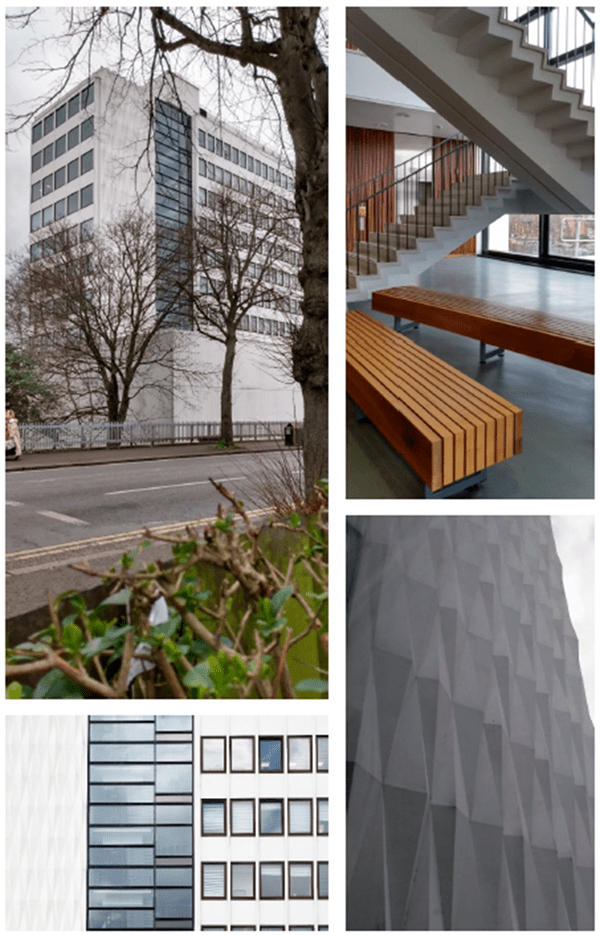
Case Study 2: Ashby Building, QUB Belfast
Originally built in 1964 to designs by Cruickshank & Seward, refurbishment of the Ashby building began in 2006. Energy efficiencies and environmental strategies are being implemented as reflected by the targeted Very Good BREEAM rating.