3.5 Improving and managing public realm
Policy DES2: Masterplanning approach for major development
Planning permission will be granted for major development where it accords with the following masterplanning principles:
(e) Contribute positively to the improvement of the public realm within, and in the proximity of, the development through the use of high quality materials and street furniture.
(f) Include an appropriate landscape management plan, early in the planning process, as an integral part of the landscape proposal.
3.5.1 Inclusive design is defined as that which meets the needs of all users and in its broadest sense means creating places that can be enjoyed by all. Development proposals should not try and mitigate perceived social problems by turning their back on neighbouring areas. Developments proposing gated access which restricts public access can lead to unsustainable, inward looking communities.
3.5.2 For major developments it is of particular importance that the design and implementation of public realm is of high quality, clearly defined with sufficient measures in place to ensure an adequate degree of passive surveillance and overlooking in order to prevent crime and maintain public safety. New public spaces should allow for adaptable uses that connect and enhance existing spaces with a palette of materials that complements the character of surrounding buildings. In addition to hard landscaped areas, the opportunity should be taken within new developments to incorporate usable green spaces to address the shortfall experienced across the city centre.
3.5.3 In cases of hard landscape the design should pick up existing details such as paving materials and sizes of paving units with an integrated approach taken in the design and siting of elements within the public realm such as seating, signage, bins, railings, lighting, public art and cycle storage etc. to ensure that these elements are carefully coordinated and align with wider public realm works.
3.5.4 The desire to create interesting, active and diverse public realm that contributes socially and environmentally to the city can sometimes cause conflicts with the desire to minimise maintenance costs or avoid undue risks. Such issues need to be considered at the initial design stage and may include the implementation of a landscape maintenance plan. In such cases, the quality of the landscape design should be beneficial to occupiers and can in many cases improve the value of the scheme which may offset any future maintenance costs.
3.5.5 Designers should ensure that landscaping proposals are as far as feasibly possible low maintenance, whereby they do not require frequent pruning, weeding or cleaning. This may impact the selection of plants species, surface materials and street furniture. It is also important that adequate safety precautions are considered for example where a scheme seeks to incorporate blue infrastructure and suds. Here the design should aim to keep pedestrian movement within designated paths orientating people away from any perceived risks. In some cases, this can be managed through innovative planting and landscaping. Where possible the use of safety barriers and physical interventions should be avoided as such infrastructure can lead to a cluttered and unwelcoming space.
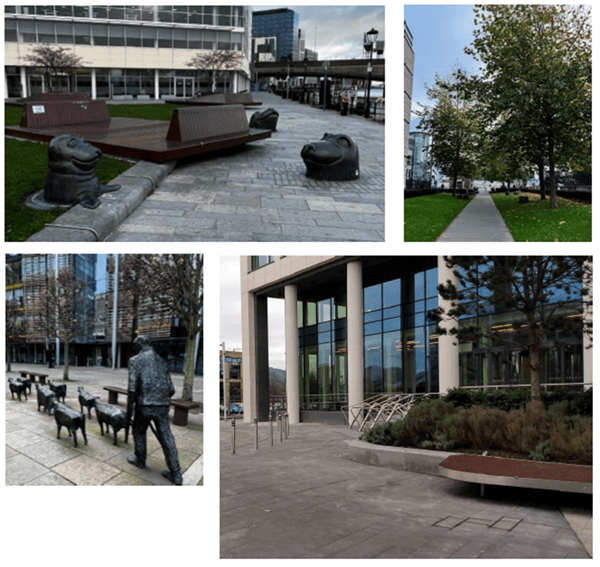
Images 14 to 17: Public realm
Examples of high quality public realm across the city centre which have resulted in a series of transitional and dwell spaces that include seating, lighting, tree/shrub planting, wayfinding signage and artwork.