


1.1 History
The earliest descriptions of the landscape around the northern Lagan Valley date from the late 16th century. A map from this period by Francis Jobson is of particular interest as it distinguished areas with tall growing trees from areas of scrub. Jobson indicated that the lands southeast of Lough Neagh and in mid-Down had tall woodland trees. The districts around Carrickfergus, North Down and the Ards Peninsular were largely devoid of woodland and the Lagan Valley contained predominantly underwood.
With the development of the town of Belfast in the 17th century, much of the woodland in the northern Lagan Valley was cleared for agriculture, cut for firewood or used in industries such as ship building, tanning and charcoal-making for ironworks. However, some leases instructed tenants to retain trees and plant hedges and saplings, and surviving records for the Donegall estate from the 1730s and 1740s refer to the employment of men termed ‘wood rangers’, who looked after trees and hedges. A large woodland was retained at Cromac (lower Ormeau) until the 1790s, when the last trees described as principally oak with some ash and alder were felled. Also, recent tree ring dating at Belvoir Park has demonstrated that some of the imposing oaks that today grace this site have grown undisturbed since the mid - 17th century.
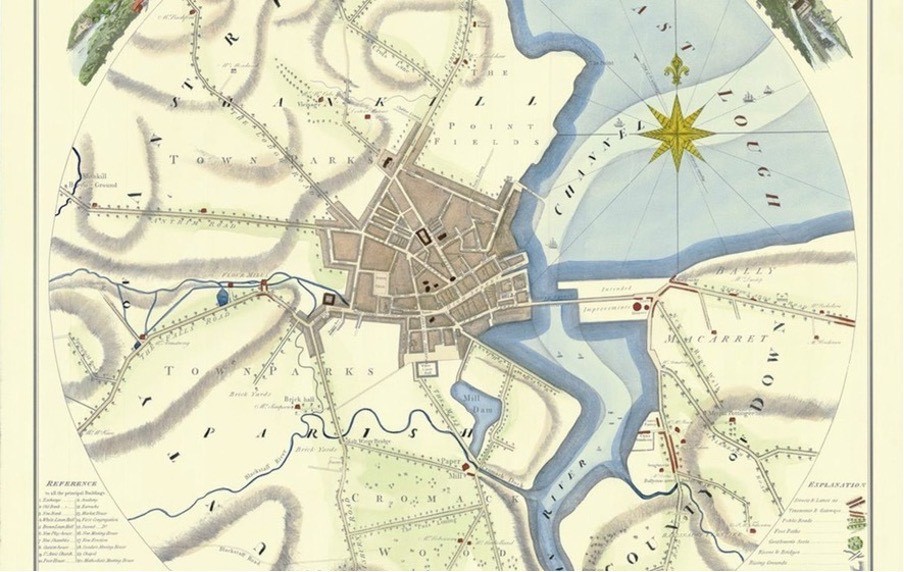
In the second half of the 18th century large scale tree planting started, supplied by local nurseries that advertised the sale of a wide variety of species including non-native trees and fruit bushes. Planting continued during the Victorian era in gardens, estate lands, on hill slopes such as Cave Hill, Colin Glen and Cregagh Glen.
Following the formation of the Belfast Botanic and Horticultural Society in 1827 a 14-acre site was purchased at the junction of the Malone and Stranmillis Roads for the Belfast Botanical Garden which opened in 1828. Its diverse collection of trees and shrubs from around the world were primarily for the enjoyment of the Botanic Society’s members until it became a public park in 1895 when the Belfast Corporation bought the gardens. Belfast's first public park (Ormeau Park) in the south of the city, opened in 1871 on land adjacent to the River Lagan, that was formerly part of the Donegall family estate. It already had many fine mature trees and these were supplemented by much new planting. In the late 19th and early 20th century, several new and extensive public parks were opened by Belfast Corporation, many of which also had plenty of fine mature trees. Following the Belfast Burial Ground Act (1866) the Corporation opened the Belfast City Cemetery near the Falls Road in 1869. This was followed by a number of other public and private cemeteries that added greatly to the city’s open space and tree cover.
In 1900, the Corporation formed its Cemeteries and Public Parks Committee from what had previously been two separate committees. This was the forerunner of Belfast City Council’s City and Neighbourhood Services Department that now manages some 49 public parks, 9 cemeteries, and the vast numbers of trees and shrubs within them.
In 1846, Belfast Corporation established the Improvements Committee, part of whose duty was to initiate street tree planting. Unfortunately, there is little recorded evidence of this earliest planting. In 1900, street tree planting was taken over by the newly-formed Cemetery and Public Parks Committee. Most of these early street tree plantings were undertaken before and immediately after the First World War and comprised a limited range of species such as limes and London planes. By the late 1960s, pollution in the city had reduced to a level where a greater variety of species could be planted, such as hornbeam, cherry, birch, and rowan. From the late 1980s, systematic street tree planting in Belfast increased significantly with many more roads being planted, particularly in the suburbs. A considerable amount of this planting was initiated by the Belfast Development Office and by 1993 there were over 9000 street trees recorded on Belfast City Council’s tree inventory.
Throughout the 20th century, Belfast’s suburbs expanded steadily and many of the new residential properties, particularly in the wealthier districts, had quite large gardens. With the increasing popularity of gardening as a pastime, many were planted with some trees and shrubs, which then contributed substantially to the overall tree cover in the city. In contrast, much of the 20th century was marked by decades of neglect of woodlands and the felling of trees when the grounds of former big houses and private estates were sold.
In the period following the Second World War both statutory and voluntary organisations started to promote trees and woodlands and to advocate the protection of trees. The first big tree campaign in Northern Ireland was launched by the National Trust in 1945 to save woodland at Colin Glen in west Belfast. Tree Week was initiated in Northern Ireland in 1967 and has since been adopted throughout the UK as the main annual celebration of trees. The protection of trees through Tree Preservation Orders was introduced into Northern Ireland legislation in 1973.
By the 1970s it was widely acknowledged that because of a lack of planting and management, most woodlands had an uneven age structure, with a predominance of mature trees and few saplings or developing trees. In response, statutory organisations together with voluntary sector environmental organisations started to develop large scale tree planting projects and place greater emphasis on tree care.
The need for a co-ordinated approach in the planting, maintenance and management of city trees led to the development of the Forest of Belfast (FoB) urban forestry initiative, which was launched in 1992. Its original thrust was as an urban planning initiative and this led to the concept of urban forestry being given official recognition in Northern Ireland. The establishment of an extensive urban forest was included as an objective in the draft of the Belfast Urban Area Plan (published by the Department of the Environment (NI) in November 1987 and confirmed in the final document published in 1990 (DoE(NI), 1990).
The Forest of Belfast then developed into a city-wide urban forestry initiative involving a partnership of the public, voluntary and private sectors and operated for over two decades. During this time the project produced a comprehensive survey of Belfast’s trees, detailing the structure and composition of the tree cover, as well as its condition and ownership. Not only was this data crucial for informing where Belfast should be tree planting in the 1990s and early 2000s, it also serves as a useful datum point and yardstick for measuring its impact today against the more recent i-Tree Eco urban forest survey.
In recent years new tree schemes have been developed, such as the Million Trees Belfast initiative, and public support for trees and tree planting continues to grow. There is now widespread awareness of the importance of trees for recreation, amenity and for our mental health and well-being; for increasing biodiversity and for mitigating climate change. In addition, the need for planting and management to counter an increasing number of tree pests and diseases is widely appreciated.
What is the urban forest?
The urban forest consists of all the green infrastructure in an urban area. This includes trees, hedges, and vegetation which can be found anywhere from deliberately planted roadside trees to vegetation found in bodies of water. The urban forest provides benefits to those who live among it. These benefits include, air pollution removal, carbon sequestration and storage and reducing flood risk. Other social benefits such as an increase in house value, amenity value of trees and health benefits for residents are also increased in a diverse, healthy urban forest.
Further Reading
- Britt, C and Johnston, M (2008) Trees in Towns II: A new survey of urban trees in England and their condition and management. Department for Communities (DfC) and Local Government:
London - DoE Roads Service (1993) Belfast Street Trees. Department of the Environment (DoE), Northern Ireland: Belfast.
- Johnston, M (1995) The Forest of Belfast: healing the environment and the community. Arboricultural Journal 19, 53-72.
- Scott, R. (200) A Breath of Fresh Air: The Story of Belfast’s Parks. The Blackstaff Press: Belfast.
- Segoviano, A (1995) Belfast's Trees - A Survey of Trees in Greater Belfast. The Forest of Belfast Project: Belfast.
- Simon, B (2009) If Trees Could Talk: The story of woodlands around Belfast. The Forest of Belfast: Belfast.
