


T3 Species Diversity
Diversity is an important aspect of the urban forest to monitor. Trees are split into families, genera, species and varieties and it is essential to have a mix of these to create a diverse urban forest. However, maintaining a high level of both inter- and intra- species diversity is also key to urban forest sustainability. Sufficient tree diversity can increase overall resilience in the face of biotic and environmental stresses and threats. A more diverse tree-scape is better able to deal with possible changes in climate or pest and disease impacts.
Understanding the species diversity of Belfast’s existing urban forest is a vital first step. From there, tree planting and management plans can enhance the diversity in line with the goals and KPI’s of the action plan. The recent i-Tree Eco study indicates that Belfast's top three most common species (Ash - 11 per cent, Sycamore - 9 per cent and Beech - 5 per cent) account for 25.8 per cent of the population.
Santmour’s (1990) 10-20-30 rule for species, genus and family, and Barker’s benchmark of 5 per cent per species are useful tools in assessing and providing targets for species diversity in the urban forest. Ideally, the array and location of suitable tree species would be so diverse that no single species would represent more than 5 per cent of the tree population across the municipality or more than 10 per cent in any given neighbourhood. However these rules apply only to street tree populations.
For landscape scale approaches Hubbell’s dominance diversity curves can be a more useful aid to visualise species diversity. The longer and shallower the curve, the greater the diversity.
Figure 5: Dominance diversity curves for UK cities compared with example forest types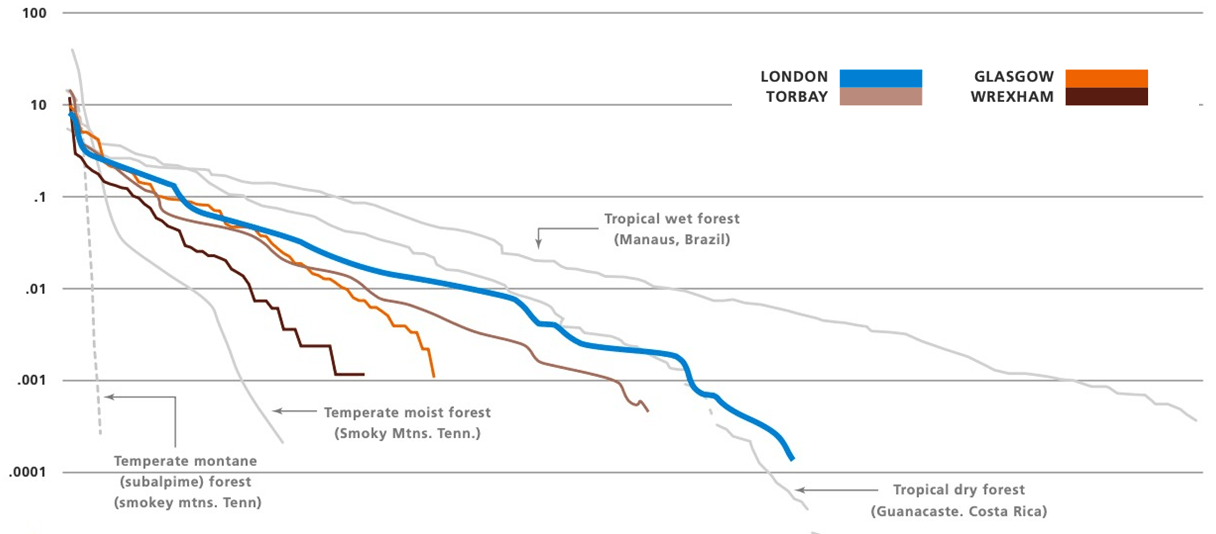
Sources and references:
Santamour, F.S. (1990) Trees for urban planting: Diversity, uniformity and common sense, in: Proceedings of the Conference Metropolitan Tree Improvement Alliance (METRIA). pp. 57–65.
Barker, P.A. (1975) Ordinance Control of Street Trees. Journal of Arboriculture. 1. pp. 121-215.
Beeauchamp, K. 2016 Measuring Forest Tree Species Diversity. Forest Research.
Rosindell, J., Hubbell, S.P. and Etienne, R.S., 2011. The unified neutral theory of biodiversity and biogeography at age ten. Trends in ecology & evolution, 26(7), pp.340-348.
Actions
- Assess Belfast’s street tree diversity to Santamour’s Rule and also across the entire urban forest using Hubbell’s dominance diversity curve method.
- Review every 10 years.
Relevant corporate policies
| Priority | Responsibility for action | For review |
|---|---|---|
| High | 1. Belfast City Council 2. Research Partner | To be confirmed - short term project |
| Current Performance Level | Performance Indicators | |||
|---|---|---|---|---|
| Low | Low | Moderate | Good | Optimal |
| Five or fewer species dominate the entire tree population across municipality. | No single species represents more than 10 per cent of total tree population; no genus more than 20 per cent; and no family more than 30 per cent. | No single species represents more than 5 per cent of total tree population; no genus more than 10 per cent; and no family more than 15 per cent. | At least as diverse as “Good” rating (5/10/15) municipality-wide – and at least as diverse as “Moderate” (10/20/30) at the neighbourhood level. | |
