


C7 General Appreciation of Trees as a Community Resource
In order for the strategy to be a true success, one of its legacies should be that the people of Belfast love, respect and appreciate its trees. By engaging and encouraging the community in this way, it can be ensured that the urban forest will be protected and enhanced for generations to come. Changing peoples values can be difficult, but through education, celebration and engagement, the hope is that people will come to value the trees around them and the wider part which they play in the health of the city, the nation, and the world.
Not only local communities, but also stakeholders from all sectors and constituencies within the city – private and public, commercial and nonprofit, entrepreneurs and elected officials, community groups and individual citizens – should understand, appreciate, and advocate for the role and importance of the urban forest as a crucial community resource.
“Having public agencies, private landholders, the green industry, and neighbourhood groups all share the same vision of the city’s urban forest is a crucial part of sustainability. This condition is not likely to result from legislation. It will only result from a shared understanding of the urban forest’s value to the community and commitment to dialogue and cooperation among the stakeholders.”
Clark et al., 1997
Figure 13: Tree Tag Examples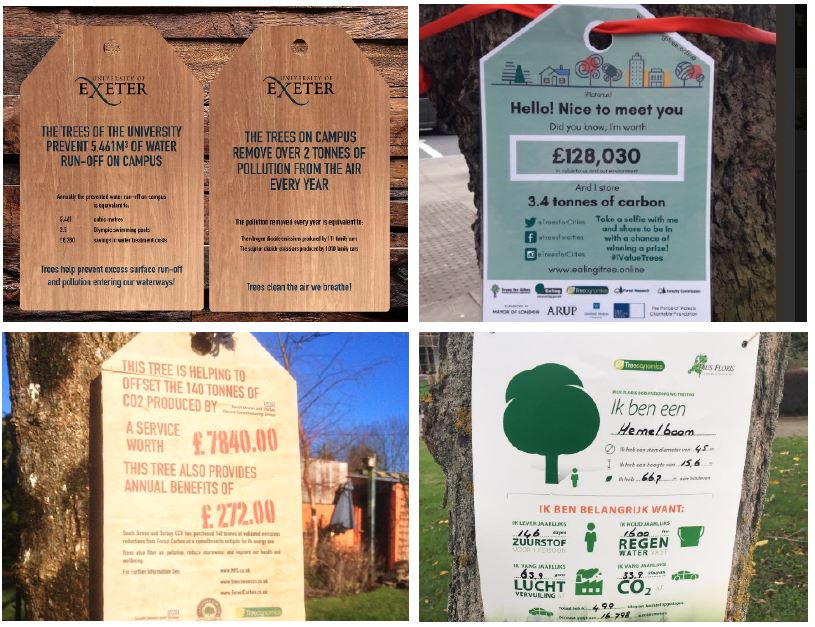
Sources and references:
Clark, J.R., Matheny, N.P., Cross, G. And Wake, V. (1997). A Model of Urban Forest Sustainability. Journal of Arboriculture. Volume: 23. Issue: 1
Actions
- Investigate setting up a local tree awards scheme.
- Review methods for gauging and measuring this target.
Relevant corporate policies
- Belfast Open Spaces Strategy
- Belfast Metropolitan Transport Plan
- Belfast Green and Blue Infrastructure Plan
| Priority | Responsibility for action | For review |
|---|---|---|
| Medium | 1-2. Belfast City Council | TBC - Short to Medium term project |
| Current Performance Level | Performance Indicators | |||
|---|---|---|---|---|
| Moderate | Low | Moderate | Good | Optimal |
| General ambivalence or negative attitudes about trees, which are perceived as neutral at best or as the source of problems. Actions harmful to trees may be taken deliberately. | Trees generally recognised as important and beneficial. | Trees widely acknowledged as providing environmental, social, and economic services – resulting in some action or advocacy in support of the urban forest. | Urban forest recognised as vital to thecommunity’s environmental, social, and economic well-being. Widespread public and political support and advocacy for trees, resulting in strong policies and plans that advance the viability and sustainability of the entire urban forest. | |
