


1.2 Current State of the Urban Forest
The urban forest of Belfast is a vital resource for the city and the rapid growth of statutory and voluntary organisations undertaking tree projects prompted the inclusion of a policy on urban forestry in the Belfast Urban Area Plan 2001 (Published in 1990). This policy to ‘make trees an integral part of the urban fabric led to the formation of the Forest of Belfast urban forestry partnership to support a more strategic approach to tree planting and tree care. One of its very early tasks was a comprehensive survey of trees throughout Greater Belfast.
Some of the key findings of this study, Belfast's Trees (Segovinao, 1995) are reproduced in Table 1 alongside data from the 2022 i-Tree Eco urban forest assessment. It is encouraging to see that at first glance there has been significant improvement on tree numbers, tree cover and density, a testament to previous tree planting initiatives such as the community woodlands initiatives of the 60’s and 70’s, the Yew trees for the new millennium campaign and the work of the Conservation volunteers millennium tree campaign, which had planted half a million trees by 1991.
However, 14.5 per cent tree cover is still short of the 20 per cent recommended by Forest Research and the 30 per cent target by the 3-30-300 rule recommended by the IUCN. The task ahead is huge, but not impossible. Belfast’s current One Million trees campaign will go a long way to help achieve this target but only if it is complimented with other programs, that not only plant the right trees, in the right places for the right reasons, but are also able to provide care and maintenance, involve communities and measure the outcomes (both good and bad), take stock, learn and continually improve.
This strategy reflects the aims of key city partners, including Belfast City Council, existing programmes such as Belfast One Million Trees, the Belfast Local Development Plan, the Belfast Agenda and also clearly links tree planting and management with Belfast’s climate ambitions and the benefits that trees provide to health and wellbeing. The Tree Strategy will have a 10-year lifespan from its launch date and sets out a commitment to delivering key Priorities and Actions for the next 3 years.
The 37 targets, priorities and actions laid out in this 10-year Tree Strategy document will build on Belfast's previous successes and include actions around sustainable management, community engagement and on ongoing measurement of the structure and composition of Belfast's urban forest.
With ever growing concern about climate change, the loss of biodiversity and the need for sustainability we need to take action now to ensure that future generations can continue to benefit from Belfast's trees long into the future and that Belfast is able to achieve its ambitious vision for the urban forest.
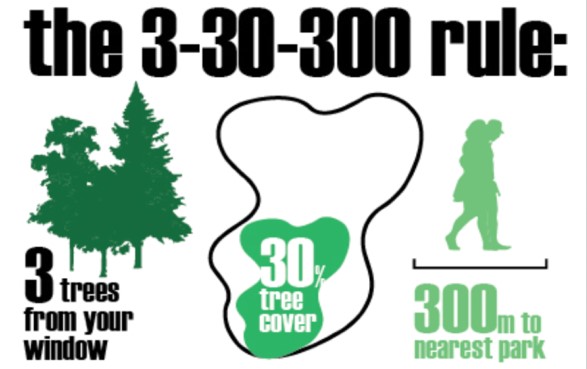
What is the 3-30-300 rule?
This rule of thumb provides clear criteria for the minimum provision of urban trees in our urban communities at the same time, it is straightforward to implement and monitor – and easy to remember.
- You should be able to see 3 trees from your window
- There should be 30 per cent tree cover in every neighbourhood
- You should only be 300m or less from your nearest park
Figure 1 - The 3-30-300 rule (Konijnendijk, 2021)
Sources and References
- Hill, D., Ruddick, J. and Walker, H. (2022). Valuing Belfast’s Urban Forest - Technical Report. Treeconomics Ltd. Last accessed: 13/07/2022. (Opens in a new window)
- Konijnendijk, C. (2021) The 3-30-300 Rule for Urban Forestry and Greener Cities
- Segoviano, A. (1995). Belfast’s Trees - A survey of Trees in Greater Belfast.
- The Forest of Belfast Project The Forest of Belfast. (1994) A Strategy Document. The Forest of Belfast Project
