


R4 Tree Equity
The urban forest should reflect the diversity of people and cultures at a neighbourhood level, and planting and management should respect the views and values of the many different communities it serves. BCC aims to progress equality in all spheres of social and economic life and empower and engage neighbourhoods.
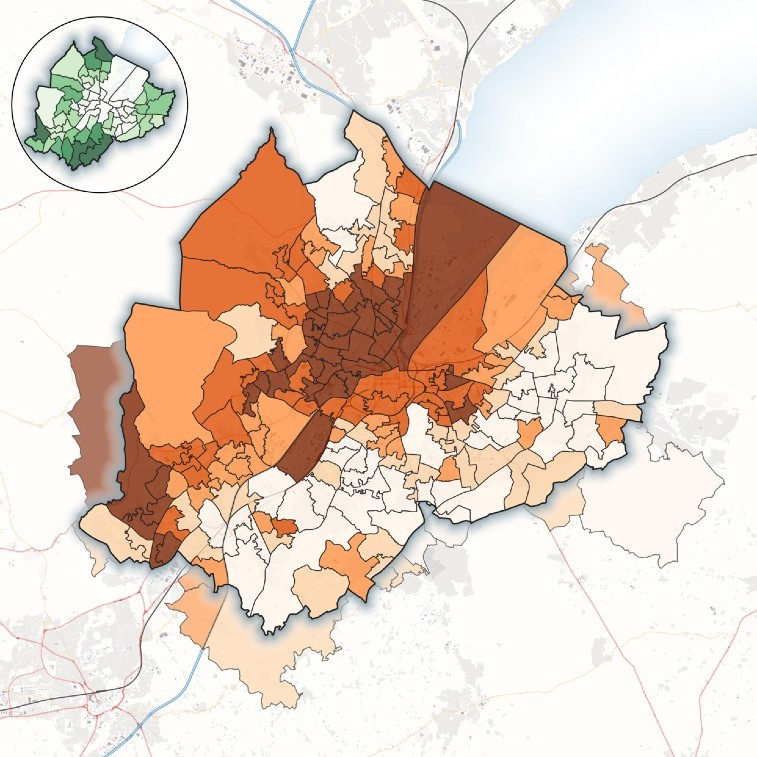
Urban forests are connected to a range of socio-economic factors, with studies linking canopy cover to health, wealth, education, and crime. Typically, lower income areas have fewer trees, and this inequality should be addressed across Belfast. Lack of tree canopy cover can also be linked to the level of urban intensification and lack of physical space to plant trees (low-cost housing with small gardens are not always suitable for trees). Therefore utilising other aspects of the urban forest such as green walls/roofs may be a part of the solution. The benefits of trees should be made available to all people in all areas of the city.
Belfast will recognise that trees and green space should be a right for all people, and environmental exclusion must be avoided.
This target aims to ensure that the planting and management of the urban forest can be focussed in the areas where it will most benefit the local people, by increasing planting in the areas with the lowest canopy cover. Tree management plans in these areas should include community engagement and neighbourhood outreach to maximise the benefits of trees in the area. The multi-faceted meanings of trees to different people should be recognised.
Figure 16: Indices of Multiple Deprivation ranking by ward (Inset: Canopy Cover by Ward)
Source: NISRA website (opens in a new window)
Contains public sector information licensed under the Open Government Licence v3.0.
Contains OS data © Crown copyright and database right 2022.
© OpenStreetMap contributors
Sources and references:
BCNUEJ, (2021). Policy and Planning Tools for Urban Green Justice-Fighting displacement and gentrification and improving accessibility and inclusiveness to green amenities.
Nesbitt, L., Meitner, M.J., Sheppard, S.R. and Girling, C., (2018). The dimensions of urban green equity: A framework for analysis. Urban forestry & urban greening, 34, pp.240-248.
Actions
- Consider a Tree Equity map for Belfast and focus efforts around tree planting and community engagement in the areas that most need it.
Relevant corporate policies
| Priority | Responsibility for action | For review |
|---|---|---|
| Medium | 1. Belfast City Council | TBC - Medium to long term project |
| Current Performance Level | Performance Indicators | |||
|---|---|---|---|---|
| Moderate | Low | Moderate | Good | Optimal |
| Tree planting and outreach is not determined equitably by canopy cover or need for benefits. | Planting and outreach includes attention to low canopy neighbourhoods or areas. | Planting and outreach targets neighbourhoods with low canopy and a high need for tree benefits. | Equitable planting and outreach at the neighbourhood level is guided by strong citizen engagement in those low-canopy/ high-need areas. | |
