


T2 Size (Age) Diversity
A healthy urban forest relies on its age diversity to maintain its ability to provide constant benefits to the people who live in Belfast over time. Maturing trees must be protected and managed to ensure they thrive and survive to become veteran trees (senescent), and juvenile trees must be planted constantly to replace old trees, dying trees, and trees removed for safety reasons. Larger, older trees typically provide more annual benefits than smaller, younger trees. However, these younger trees are vital to maintaining a healthy and sustainable forest.
Generally, the most accurate way to gauge age diversity is to compare current tree size in each species (in terms of diameter at breast height, or DBH) to the maximum diameter for that species. The goal would then be to maintain a tree population that is unevenly distributed among different age classes, making sure that there are enough juvenile trees for the future.
It is of course also important to strive for age diversity across the entire tree population – including public trees managed “extensively” (as a group) in parks and natural areas, as well as trees on private property, both city-wide and at neighbourhood level.
The recent i-Tree Eco study for Belfast gives the current age diversity across all trees as: 67 per cent Juvenile, 24 per cent Semi - Mature, 8 per cent Mature and 1 per cent Senescent.
Figure 4: Richards “Ideal” Distribution of Tree Age Across the Urban Forest Showing Typical DBH for Each Age Class.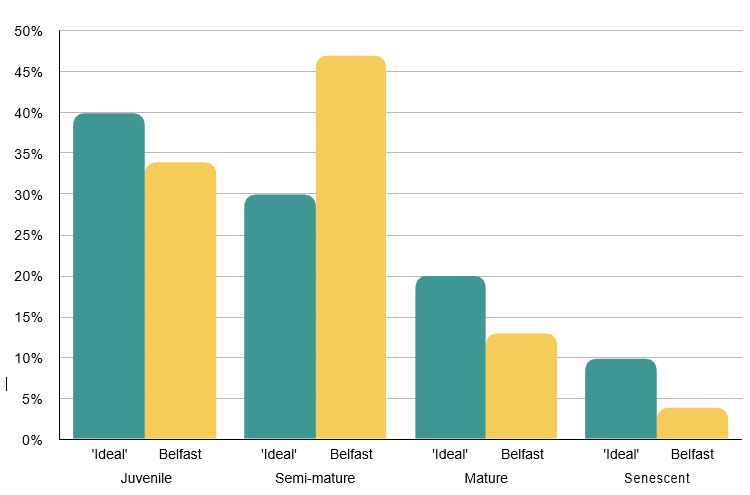
Sources and references:
Richards, N.A., (1982/1983). Diversity and stability in a street tree population. Urban Ecology 7, 159–171 – as cited in McPherson, Urban Forestry & Urban Greening 12 (2013) 134– 143.
Actions
- Review every 10 years
Relevant corporate policies
| Priority | Responsibility for action | For review |
|---|---|---|
| Medium | 1. Belfast City Council, Belfast Hills, One Million Trees | TBC - Medium term project |
| Current Performance Level | Performance Indicators | |||
|---|---|---|---|---|
| Moderate | Low | Moderate | Good | Optimal |
| Even age distribution or highly skewed toward a single age class. | Some uneven distribution, but most of the tree population falls into a single age class. | Total tree population across municipality approaches an ‘ideal’ age distribution of 40 per cent juvenile, 30 per cent semi-mature, 20 per cent mature, and 10 per cent senescent. | Total population approaches that ideal distribution borough-wide as well as at the ward level. | |
